Fana · Baqa
The sense of a separate "I" falls away in absorption in God; life becomes an abiding in divine presence.
KNOMI · Know who you are
The death of the ego. Awakening beyond the separate self.
Across cultures and centuries, mystics describe the falling away of the ordinary "I", revealing what their traditions call true nature, liberated awareness, or divine presence.
FANA · KENSHO · MOKSHA · RIGPA · THEOSIS · BITTUL · HENOSIS
Different traditions. A recurring invitation to awaken.
The pathless path to awaken to your true nature.
A perennialist view of contemplative traditions.
The sense of a separate "I" falls away in absorption in God; life becomes an abiding in divine presence.
Awakening beyond identification with body and mind to recognize the true Self as Brahman, ultimate reality.
Recognizing one's true nature as Shiva, the universal consciousness appearing as all experience.
Awakening from ignorance and clinging to "I" and "mine," bringing liberation from suffering.
Directly seeing one's true nature, beyond conceptual thinking and attachment to a separate self.
Recognizing the empty, luminous nature of awareness beyond identification with passing thoughts.
Returning to the source through clarity and stillness, living naturally in accord with the Dao.
Surrendering self-will and entering transformative union with God through love and grace.
The surrender of independent self-importance and a deep attachment to divine presence.
Freedom from ego-bound living, abiding in natural spiritual awareness and attunement to the Divine.
The soul's true knowing becomes unobstructed as karmic bondage is removed, culminating in liberation.
Transcending ordinary self-awareness in union with the One, the source of all existence.
Shared patterns of realization, expressed through different understandings of self, reality, and the divine.
The five traditions this path leans on most are compared side by side in Across the traditions.
Awakening is not a summit you climb. It is a current that is already carrying you home. The only work is to stop swimming against it.

Ten stages, in order. Each one explains a piece of the mechanism in plain words, ends with a practice you can do today, and a short self-check. Nothing is required except honesty and a few minutes a day.
Ten stages, in order. Each one explains a piece of the mechanism in plain words, ends with a practice you can do today, and a short self-check.
Every stage carries expandable "Go deeper" sections: the Sanskrit and Pali terms, the parallel teachings in each tradition, and the finer distinctions the short version leaves out.
A field guide to what actually comes up in practice, a glossary, a map across five traditions, and an index of the analogies used throughout.
Read the stages in order the first time; each one assumes the last. The short teaching at the top of every stage is enough to work with. The "Go deeper" sections are the same territory at full resolution, for when you want the scholarship, the original terms, and the cross-tradition parallels. Nothing in the deep layer is required to do the practice.
Treat every concept here as a tool to be used and then put down. The teachings are a menu, not the meal. As one Zen master warned, mistaking the map for the territory is the most common way of getting lost on this path, and it can happen with this very page.
One caution before starting: this work loosens the grip of the conditioned self, and that can feel intense. The field guide covers what to expect. If you are in a period of psychological instability, work with a qualified teacher or therapist alongside anything you find here.
Two companion paths by the same hand: The Loom of Union, a course on tantra, and The Watercourse Way, on the Tao.
Stage 1 of 10
Awakening is not something you achieve after a long, hard journey. It is a direction that life is already moving in, like a river that will reach the sea whether or not anyone pushes it. The work is to stop pushing against it.
There is a character called "you", with a name, a history and a set of opinions. And there is the awareness in which that character appears, the way a drama appears on a screen. Suffering happens when the one watching forgets it is watching and believes it is the character. Awakening is remembering. Nothing about the show has to change.
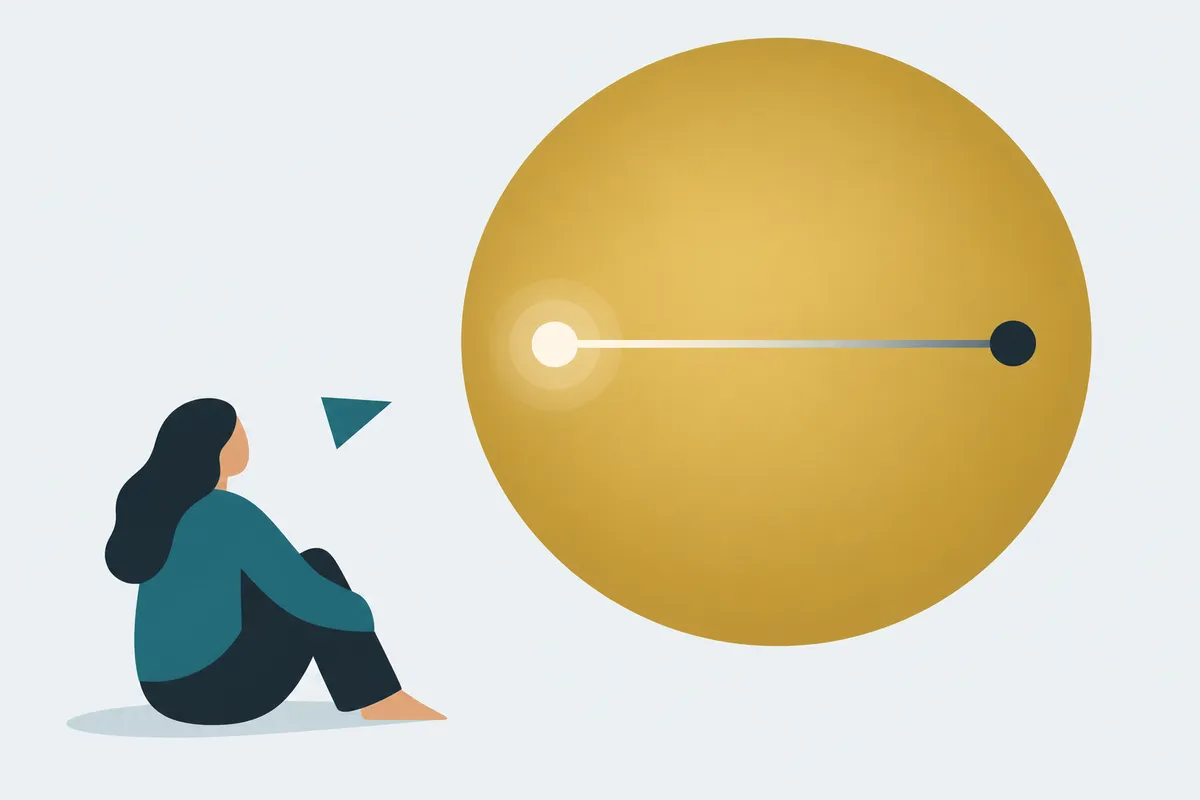
Most spiritual language makes awakening sound like a summit: rare, distant, reached by a few after heroic effort. It is more accurate, and far more useful, to picture a current. Everything that comes out of the source is moving back toward it. In the old cosmologies this was drawn as a torus, a continuous loop of going out and returning, involution and evolution, with no part of it standing still. Awakening is simply the point in that loop where the return becomes conscious.
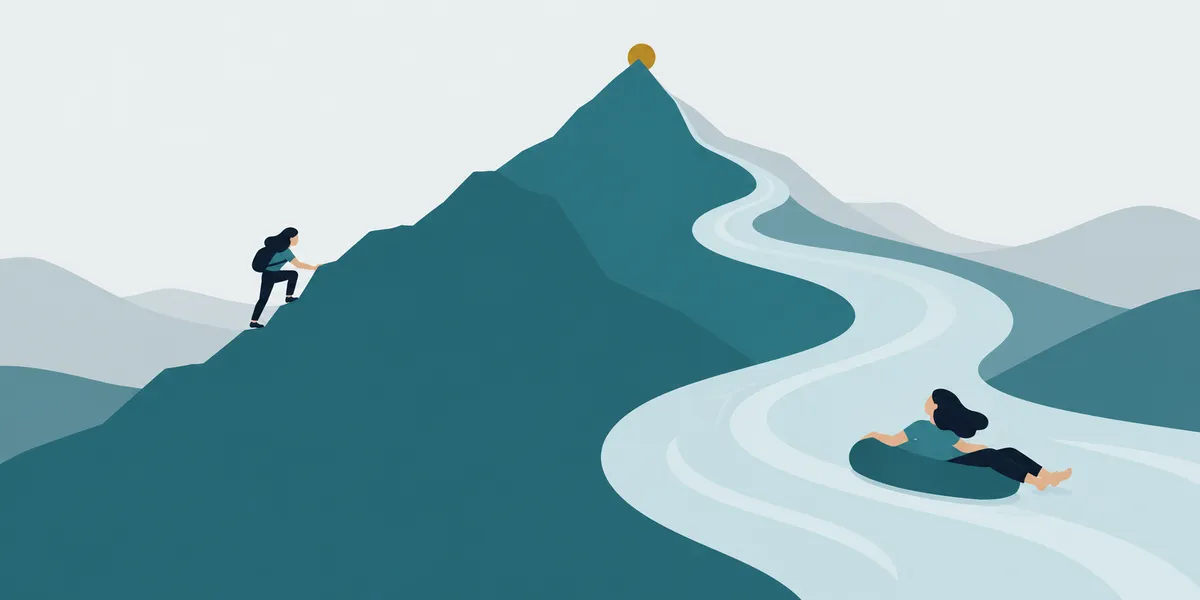
This matters practically. If awakening is a summit, then you are at the bottom and the whole thing depends on your effort. If it is a current, then the most useful thing you can do is stop swimming upstream. The traditions call this effortless effort: it takes everything you have, and none of it is directed at making something happen.
Certain conditions make the shift more likely, and that is what the rest of this path is about. But it is worth knowing from the start that people wake up in every kind of circumstance. Whenever the habitual pattern of "me" is interrupted, whether by a death, a loss, an illness, or an unexpected joy, a gap opens. What the wisdom teachings provide is a map of the mechanism, so that when the gap opens you recognise it, and so that you can remain awake instead of falling back into the dream.

Sit in front of a gripping television drama for long enough and something curious happens: you tense when the protagonist is threatened, your heart races in the chase, you feel wronged when they are wronged. For a while, you have forgotten that you are a person on a sofa. No one would say you were bound by the drama. You were simply absorbed in it, and the absorption ends the moment you remember where you are.
This is the whole situation in miniature. The character on the screen is the conditioned self: the body, the personality, the memories, the running commentary. The one on the sofa is awareness. It is always the character that suffers. Awareness has never suffered, never been trapped, and never been set free, because it was never caught in the first place. Which produces the paradox at the centre of every awakening teaching: you were never bound, so you can never be liberated. You can only discover that the binding was a mistake of identity.
The kingdom of God is not coming with signs to be observed. Nor will they say, "Look, here it is!" or "There!" For behold, the kingdom of God is within you.
Luke 17:20–21
The Christian mystics read this passage the way the Zen masters read their own: the kingdom is already here, and the only reason it goes unseen is that we look through the false self, the little "I" that is always somewhere else. Nothing needs to arrive. Something needs to stop filtering.
It is fair to ask whether all of this is worth the effort, especially since people who glimpse it very often lose it again. Some have the experience, then the ego claims it ("I did it, I awakened") and builds a spiritual persona out of the memory, which can be a more stubborn ego than the original. That is common enough to be treated as part of the path rather than a failure of it.
The honest measure of benefit is simple: when you look back over your life, is there less suffering? Practitioners who have been at this for decades report the same thing. Looking back twenty-five years, there was exponentially more suffering and identification, and now it is clear who was suffering. It was always the character. The benefit of awakening is freedom from that delusion: a life that is not scripted, not run on autopilot by patterns laid down in childhood, and a peace that does not depend on how the show is going.
There is a second benefit that is easy to overlook. Beyond freedom from the character there is freedom to: to grow, to explore what this human vessel can become when its energy is no longer spent maintaining a fiction. The traditions describe this as the growth of the inner lotus, the maturing of the human instrument. Awakening is the beginning of that, not the end.
A question always arises here: if I am not the character, who makes decisions? Do I just drift? The answer that comes from direct experience is that in the awake state there is no chooser and nothing chosen, and yet things very much happen. Life keeps moving, decisions keep occurring, but they arise the way a spider builds its web: with ease and precision and no one standing behind the process approving each strand.
The dualistic, planning mind was never designed to steer a life. It is an interface, superb for arithmetic, language and navigating the physical world, and it has been promoted into a job it cannot do. When the interface becomes the dictator, the result is the constant low-grade friction most people call normal. When it returns to its proper role, the traditions speak of choiceless awareness: feeling the current of life and moving with it. The character can still choose to fight that current, and that is exactly when suffering returns, because the current always wins.

The martial arts carry the same teaching in the body. The lineages that trace back to Bodhidharma at Shaolin (the same teacher whose sitting practice became Zen) train the fighter to drop the thinker. If you are thinking about the next move, you are already finished. The energy moves from the belly, the heart and the brow in a single dance, and the "doer" is nowhere in it.
Two words are used loosely and it helps to separate them. Awakening is the immediate recognition of unconditioned being, available in any moment, because the awareness being recognised is already here. Liberation is the long stabilisation that follows: the conditioned self learning its place, its momentum running down, the human vessel maturing until awareness can shine through it without interruption. The Zen phrase captures both at once: always being Buddha (nothing to attain), always becoming Buddha (endless unfolding).
This is why sadhana, spiritual practice, changes shape at the point of awakening. Before it, practice looks like effort: techniques, overcoming hindrances, a mind in motion trying to still itself. After it, the illusion of the doer is exposed and practice becomes simply abiding as awareness. Ramana Maharshi, asked about his own practice, said that he had never done any sadhana. He was speaking as the Self, which requires no cultivation. His body sat in a temple for years; that was the character being placed in conditions of no escape while the self-structure cleared. The two statements are not in conflict.
A rule of thumb from the same teaching: the conditioned mind makes a good servant and a poor master. Practice is not about killing the servant. It is about ending its tenure as master.
Taoism gives the image its clearest form: the Tao is the way things flow, and the sage practises wu wei, non-forcing, moving with the current rather than against it. "Heaven and earth have no preference." Water, the Tao Te Ching says, benefits everything and competes with nothing, because it is content to seek the low places.
Hinduism (Vedanta) says the individual self, Atman, is not other than the ground of everything, Brahman. The Bhagavad Gita's counsel to Arjuna to act without attachment to results is the same instruction as choiceless awareness: let the action happen, and stop claiming it.
Buddhism speaks of Buddha-nature, the awake quality already present in every being, obscured rather than absent. Dogen: practice and enlightenment are one, because you are not manufacturing awakening, you are expressing it.
Sufism describes the return to the source as the whole purpose of the soul, and the dropping of the separate self as fana, annihilation in the Beloved, followed by baqa, abiding in what remains. Rumi's verse is full of rivers running back to the sea.
Christianity holds the same current under the words "not my will but Thine", and in the mystical reading of "the kingdom of God is within you". The false self stands between the person and a kingdom that is already present.
Stage 2 of 10
The sense of being a separate "I" is not a thing you have. It is a process that runs, moment by moment, in five steps that happen so fast they look like one. Watch them in slow motion and the whole structure becomes visible.
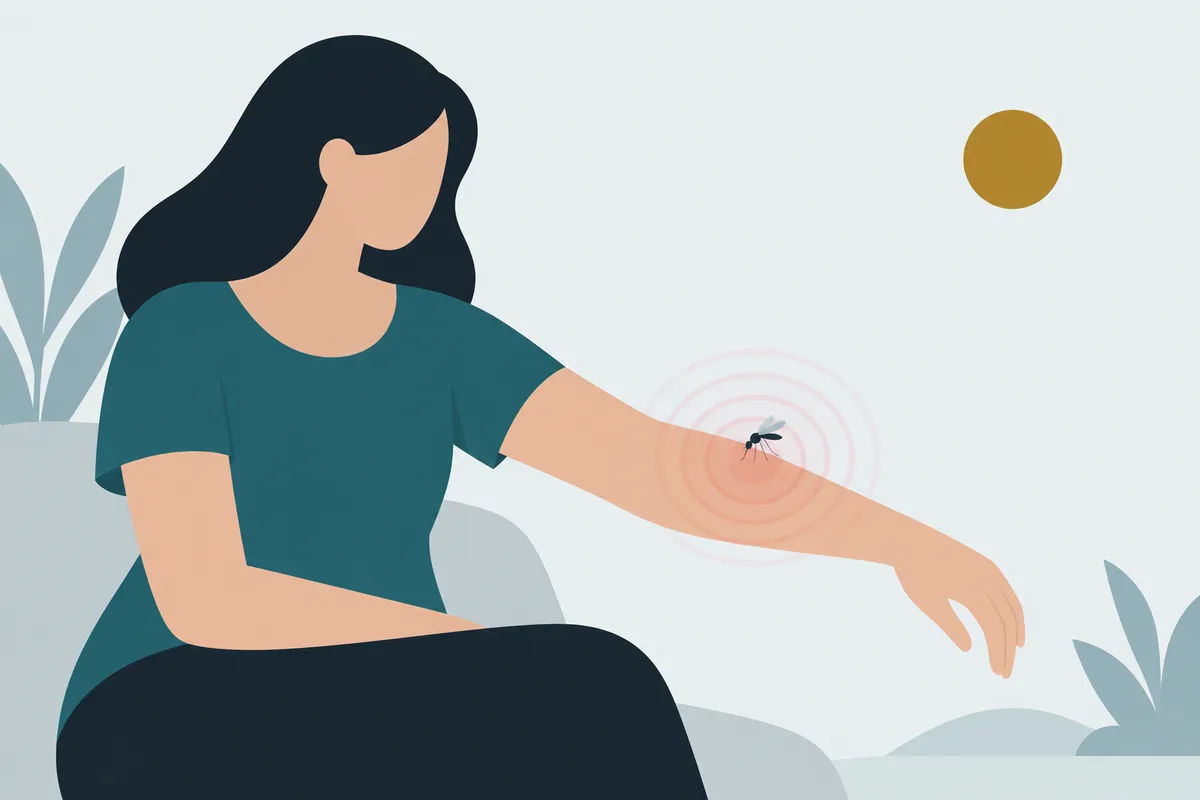
A mosquito lands on your arm. Before you have swatted it, five distinct operations have run: a body, a raw sensation, a label ("mosquito"), a reaction ("bad, get rid of it"), and a faculty of attention that watched the whole thing. The Buddha called these the five skandhas, the aggregates. Together they manufacture the feeling of "me". None of them, on inspection, is a self.
Imagine you are sitting in meditation and a mosquito begins to whine near your ear. Slow the next two seconds down and this is what runs.
The baseline: there is a body here, sitting in space. Something physical for contact to happen on. The vibration of a mosquito landing on skin.
Raw sensory input, prior to any label. A tickle, a buzz, a change in the field of the skin. At this layer it is neither good nor bad; it is simply energy registering. This layer is important because it can be felt directly, and most of us have not felt it in years. We skip straight to the next step.
The mind opens its library of memory and finds a match: "mosquito". Language, concepts, recognition. Still no preference has formed. This is the part of the mind that names things, and it is very fast.
Now the charge arrives. Past experience with mosquitoes (itching, malaria warnings, ruined nights) fuels a reaction: "bad, must be eliminated". This is the layer of craving and aversion, of "I want" and "I don't want". It is where suffering enters, and where the sense of "me" is thickest, because the preference feels like mine. The Zen poem you will meet in Stage 5 calls this labelling of things as good or bad "the disease of the mind".
The faculty of attention that observed all of the above. It behaves like a camera: it can point here or there, zoom in tight or take in a wide view. It feels like the most "me" of all the layers, the witness inside. But look closely and even this camera is a function, not a person. It has no owner. It, too, is empty of self.
What makes this model valuable is not its elegance but that every one of the five can be caught in the act. These are not philosophical categories; they are discrete operations you can watch in your own mind this afternoon. Once they are seen, they lose their automatic grip, because a process can only run you while it runs unnoticed.
Plato described prisoners chained in a cave, facing a wall, watching shadows cast by a fire behind them. Because the shadows are all they have ever seen, the shadows are reality. Anyone who is released and walks out into the sunlight comes back with news the prisoners cannot use.
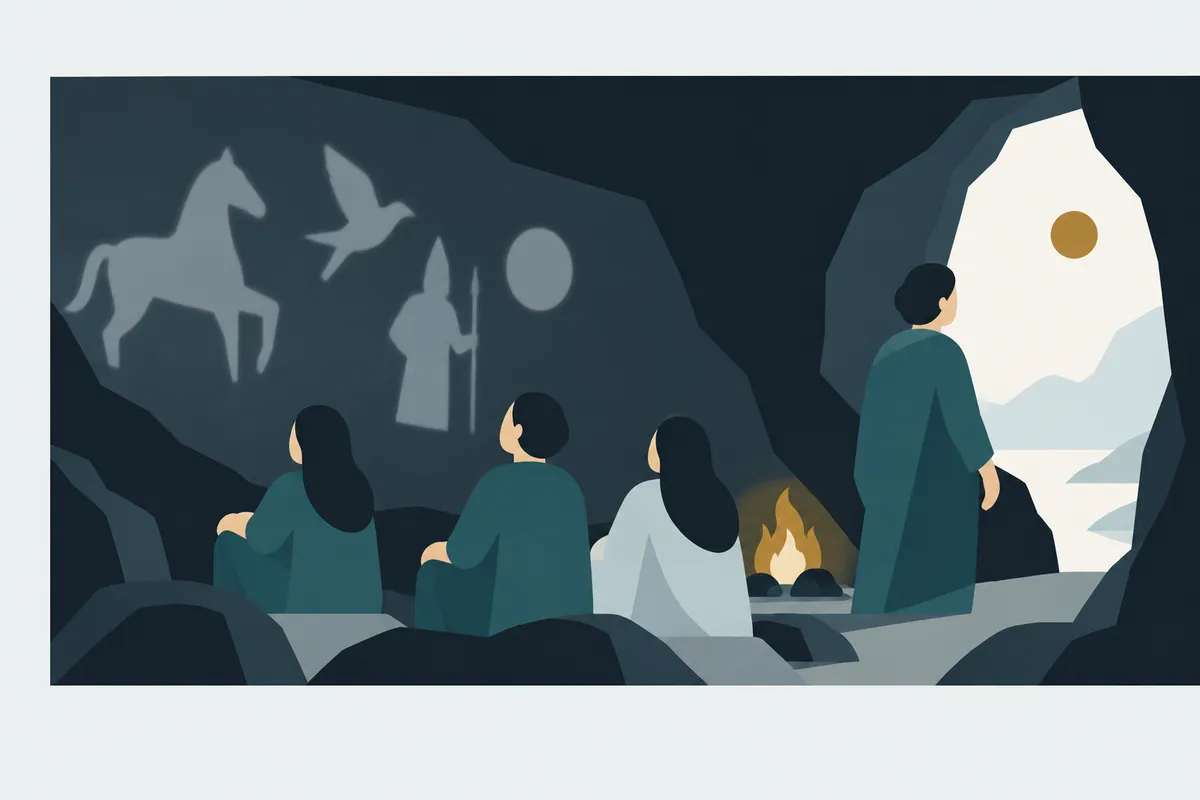
The shadows are the contents of the mind: thoughts, images, perceptions, the running commentary. We are trained toward them from the crib, where a mobile is hung above us so that we learn to fix on objects. In school, a child at a desk notices a squirrel in the yard; there is aliveness in that squirrel, and attention goes to it naturally. The teacher, focused on the lesson, says pay attention. The child learns quickly that following the natural flow of energy gets you into trouble, and that pleasing the teacher does not. The false self begins here: a cultivated network of "shoulds", inherited notions of right and wrong, a persona built to keep out of trouble. Nobody did anything wrong. It is simply how the game starts.

Awakening, in this image, is coming out of the cave. Those who have described their first glimpse often use exactly these words: it was like walking out into a world I did not know was there. And, like the freed prisoner, there is no real way back once you have seen it, though you can certainly try.
Put your attention on your left hand right now. Within a few seconds there is tingling, warmth, a sense of aliveness that was not noticeable a moment ago. Nothing changed in the hand. Attention went there, and energy followed.

The Taoists put this as a formula: chi follows consciousness, and consciousness follows chi. Modern teachers say where attention goes, energy flows. It is the single most practical principle on this path, because it explains how the self-structure is powered. The five skandhas only have power because attention is given to them. The camera of the mind swings toward a preference, energy pours into it, the pattern strengthens, and the pattern pulls the camera back next time. That loop, running unobserved for decades, is what a personality is.
It also explains why the way out is not a fight. When attention stops feeding the loop, whether by resting as awareness or by fully seeing the pattern, the energy trapped in it is released. The body fills with it. The practitioners of every tradition describe this release in the same terms: as if there were no longer a body, only an ocean of aliveness. The Sanskrit compound for it is sat-chit-ananda: being, consciousness, bliss. The bliss is uncaused; it is not produced by any of the five skandhas. It is what is left when they stop consuming the energy.
In Zen, a period of concentrated practice is sometimes called “gathering the heart-mind”. The heart here is not sentiment. It means the Self: that which remains through waking, dreaming and deep sleep, before every passing version of you. The Prajñāpāramitā, or Heart Sutra, speaks from this heart. It is not a philosophy to solve. Its contradictions are meant to land beyond the mind that makes opposites.
Its movement is simple and complete. An awakened being looks into the five skandhas, sees that each is empty of a separate self, and thereby ends suffering. “Form is exactly emptiness, emptiness exactly form.” Then the sutra keeps subtracting: in emptiness no eye, ear, nose, tongue, body or mind; no colour, sound, smell, taste, touch or object of mind. With nothing to grasp there is no hindrance; with no hindrance, no fear. Its mantra carries the same movement: Gate gate pāragate pārasaṃgate bodhi svāhā — gone, gone, completely gone, gone beyond, awake.
You can test this rather than believe it. Watch form, raw sensation, perception, preference and witnessing as separate operations. Each can become conscious and drop individually. Even physics offers a literal hint: what feels solid is almost entirely empty space. But the sutra goes further than a claim about matter. It asks what remains when every way of dividing emptiness from form has gone.
The vase-and-faces picture makes the last difficulty visible. Seen one way, the vase is the whole sensory field. Seen another, two faces appear as its witness. The flip is peaceful, but both readings belong to one picture. The witness is still a function of mind — in Ken Wilber’s phrase, “the last hold-out of the ego”. Who is aware of the field, the witness and the flipping between them? That awareness has zero qualities and no job. It does not aim the camera or improve the scene; it is simply aware.
The whole picture, including the witness, is already appearing to what you are.

A virtual-reality headset offers the same clue. Inside the game you take an avatar to be yourself, yet the one playing is unchanged when the character, world or story changes. The one who takes off the headset is the same one who wore it. Awakening is not a better avatar. It is recognising who has been taking in the game all along.
The witness can feel like arrival because it is quiet compared with the show. Thoughts, sensations and reactions move in front of it while it seems untouched. There is less suffering there, and it is easy to hang out as the detached observer. This is a genuine opening, but it still contains a split: a watcher here, a world there.
Anything that can be noticed is inside experience. The witness has a position, a direction and something to witness, so it remains the fifth skandha, vijñāna. Ask what knows even this watcher. Do not answer with another observer; that only moves the line back. When the division between witness and witnessed collapses, form is not standing opposite emptiness. The picture is whole, and no separate one remains outside it to claim the view. That collapse, not a more peaceful seat on one side of the split, is the awakening.
Many practitioners arrive at the fifth skandha and stop. They discover a detached watcher behind thought and take it to be their true nature. It is a real discovery and a genuine stage, but the traditions are unanimous that it is not the end. The witness and the witnessed arise together; they are the two poles of a single duality, the yin and yang of the mind. As long as there is a watcher here and a world there, you are still inside maya, the play of appearances.

The first four skandhas can be summarised as "the field of change" and the fifth as "the observer of change". Meditation and self-inquiry both aim at realising the entire mechanism, all five, as empty of self. When that is seen, the fifth collapses into the field it was watching. The Heart Sutra's line, "form is exactly emptiness, emptiness exactly form", is the report of that collapse. Stage 8 describes what riding a roller coaster feels like from the witness, and then from beyond the witness.
This is also why it is said that awareness has no quality. The camera has qualities: direction, focus, width. Awareness is what the camera and its images appear in. You cannot point it anywhere, because it is not a thing that points.
Vedanta describes the person as five sheaths (koshas) wrapped around the Self: the physical body, the energy body, the mental body, the body of discernment, and the body of bliss. Like the skandhas, the sheaths are examined one by one and found to be coverings rather than the thing covered. The Kena Upanishad asks what it is that the eye cannot see but by which the eye sees, and answers: that alone is Brahman, not what people worship as an object.
Taoism works the energetic layer directly. Its vocabulary of chi, the three dantian (the energy centres of belly, heart and brow) and the circulation of energy through the body is the practical science of vedana, the second skandha, and of the principle that chi follows consciousness.
Christian mysticism speaks of the old self and the new, or, in Thomas Merton's phrase, the false self and the true self. The false self is exactly this cultivated persona: "the self that is made of shoulds". Paul's distinction between living "according to the flesh" and "according to the Spirit" is read by the mystics as the same distinction between the conditioned mechanism and what is prior to it.
Sufism names the conditioned self the nafs, and describes its purification through stages, from the nafs that commands toward its cravings, through the nafs that reproaches itself, to the nafs at peace. The mosquito's fourth step is the commanding nafs at work.
Stage 3 of 10
If awakening is a recognition, why does anyone need to practise? Because recognition does not stop a pattern that has been spinning for forty years. This stage is about karma, understood not as cosmic bookkeeping but as inertia.
Awakening is like pulling the plug on a ceiling fan. The blades keep turning for a while on their own momentum. That momentum is your accumulated conditioning. Every time you react to a preference, you plug the fan back in. Practice is the art of not plugging it back in, for long enough that the blades come to rest.
Every strongly charged experience that was not fully felt at the time leaves a residue. The Sanskrit word is samskara (Pali: sankhara), often translated as "impression" or "formation". Picture water running over soft ground: it cuts a channel, and the next rain runs down the same channel, deepening it. Samskaras are the channels. They are where energy will flow unless something diverts it, and they are stored in the body as much as in the mind, as knots of contraction around the chest, the belly, the throat.
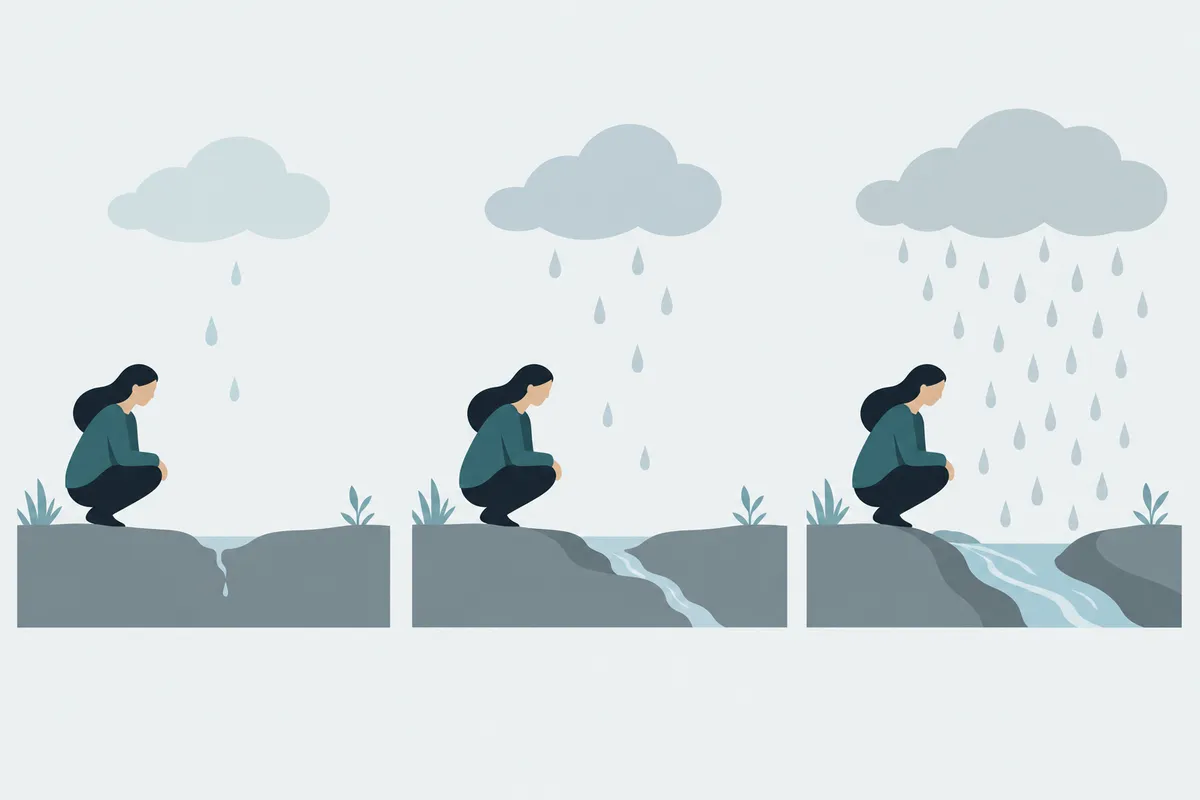
This gives a clean definition of karma that does not require any belief: karma is the tendency of energy to follow established pathways. Nothing more mysterious than a riverbed. When consciousness slips back into an old pattern, energy flows down the old channel and the pattern reinforces itself. When it does not, the channel begins, slowly, to fill in.
In the moment of awakening, identification with the mind and its reactions ceases. The plug is out. But the mind-body is a physical system with momentum; it does not stop because the power has been cut. Thoughts keep arising, preferences keep firing, the personality keeps performing. The blades are still going round.
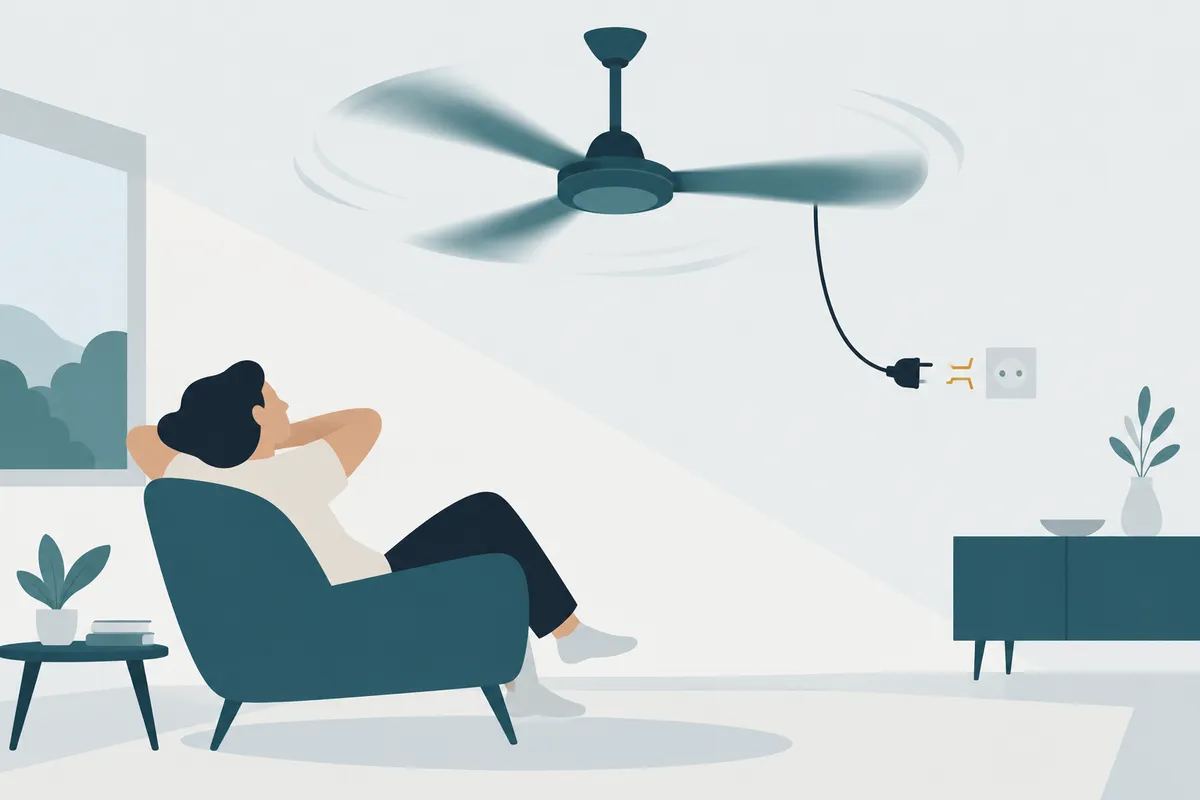
Here is the crucial point, and it is easy to miss. As long as the plug stays out, the fan slows and eventually stops. Every time you identify with a preference the mind produces and react to it, you have reached over and plugged the fan back in. Not because you are bad at this, but because that reach is the habit. The entire discipline of the path after awakening comes down to noticing the hand reaching for the socket.
Stated in physics: a mind in motion stays in motion unless acted on by an outside force. All spiritual practice is that outside force, a consciousness that diverts energy from its conditioned pathways. This is why someone can meditate for years and change nothing if they go straight back to the same routines, relationships and defences. The wiring stays in place because it is being used. You have to be willing to change your life, not as a moral requirement but because the old life is the socket.
Of all the strands that tie the sense of "I" to the character, two are primary. The body is attached to comfort. It seeks pleasant sensation and avoids discomfort without pause, which is the mechanism of an animal ensuring its survival, now running in a creature that is not in danger. The mind is attached to knowing. It wants to understand, conceptualise, predict and control, and it will accept a bad explanation over no explanation every time. Because when the mind knows, it believes it is in control.
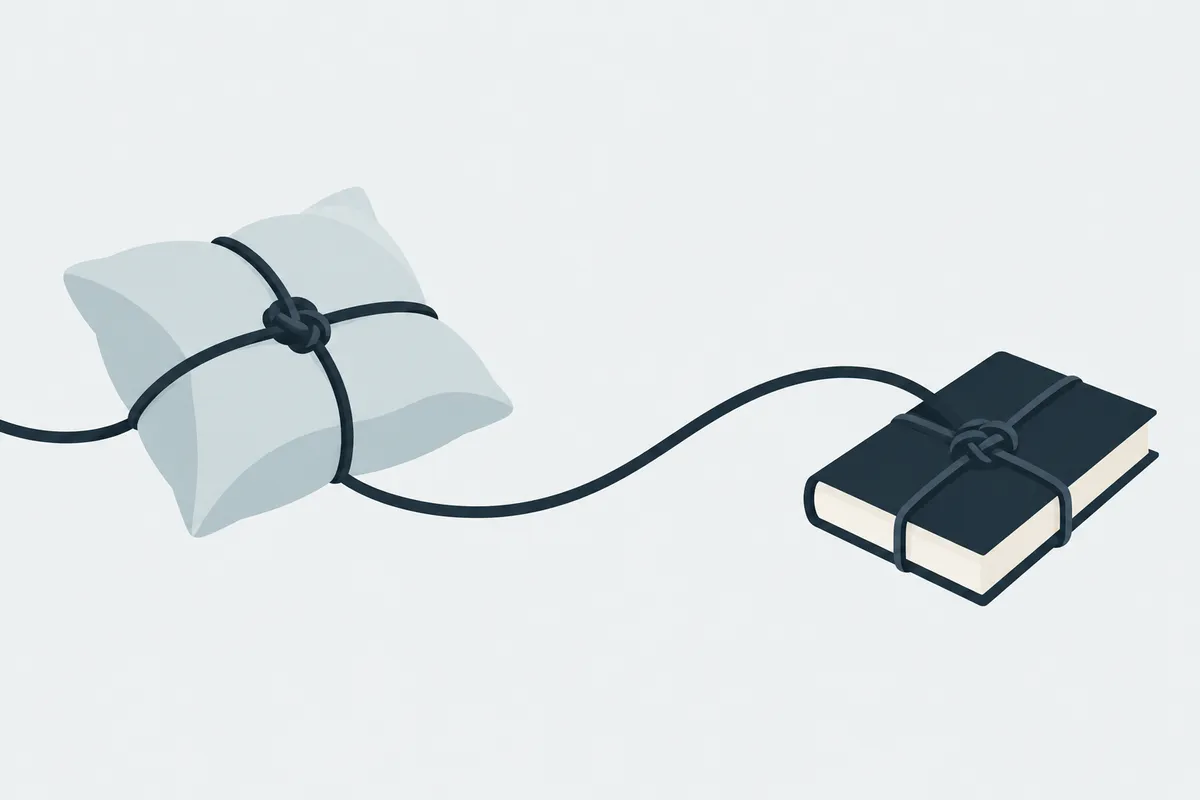
Every hindrance you will meet in practice (Stage 4) is one of these two knots pulling. Restlessness, pain, boredom and sleepiness are the comfort knot. Doubt, analysis, planning and the search for the right technique are the knowing knot. Seeking comfort with the body and knowing with the mind, we remain like herd animals: craving pleasure, avoiding pain, endlessly responding to stimulus, endlessly doing, and unaware of the dimension of being.
The alternative is a phrase worth memorising: present without choosing. To be fully attentive to what is happening, without the mediation of conditioning, without concepts, without controlling or manipulating what arises, is to be present without choosing, and therefore without a chooser. The knots loosen not by force but by being neither obeyed nor fought.
In the pursuit of learning, every day something is acquired. In the pursuit of the Tao, every day something is dropped.
Tao Te Ching, chapter 48
Why do retreats exist? Because in ordinary life the character always has an exit. When practice becomes uncomfortable, there is a phone, a snack, a conversation, a task. Each exit is a socket. A retreat is engineered to remove the exits, to create conditions of no escape for the ego, so that what it has been avoiding has nowhere to go but up into awareness. This is not cruelty. It is the fan being kept unplugged long enough to slow.
The same principle can be built into a day: a fixed sitting time that is not negotiated, a period without media, a commitment not to move during a sit. The point is never to brutalise the body or mind (see the note on productive and unproductive pain in Stage 4), but to stop offering the pattern its usual escape routes.
Yoga's classical texts describe the goal as chitta vritti nirodha: the cessation of the whirlpool of the mind. A whirlpool is not a thing; it is water going round. Stop feeding it and it is simply water. The related terms vasana (latent tendency) and klesha (affliction) name the same momentum from different angles: the deep unconscious patterns that produce the limited sense of "I" and the suffering that attends it.
Buddhism: sankhara is the fourth aggregate and also the second link in the chain of dependent origination, the "formations" that arise from ignorance and drive rebirth, moment to moment. To burn them up is the literal meaning of jhana (Stage 6).
Hinduism: samskara, vasana and karma form a single vocabulary of momentum. The Gita's answer is action without attachment to the fruit, which is precisely refusing to plug the fan back in while still letting the blades do what they do.
Taoism: the Tao Te Ching's daily "dropping" is the fan analogy stated as a practice. Wu wei, non-forcing, is not passivity; it is acting without the extra layer of grasping that creates new channels.
Christianity: Augustine described habit as a chain forged link by link until it holds you fast, which is a samskara in Latin. The contemplative instruction "be still, and know" (Psalm 46) is the instruction to stop reaching for the socket.
Sufism: the disciplining of the nafs, and the great saying "die before you die", both describe letting the momentum of the self run down while still alive, so that what remains can be seen.
Stage 4 of 10
There are hundreds of meditation techniques and they all do the same two things. Once you see what those two things are, the technique matters much less, and what comes up while you do it matters much more.
Every technique combines concentration (staying with one thing) and surrender (not reacting to what arises). Together they interrupt the habit pattern of the mind. When the pattern is interrupted, its defences come up as hindrances: pain, sleepiness, restlessness, doubt, a busy mind. These are not obstacles. They are the exact material that needs to be made conscious, arriving on schedule.
Breath-watching, body scanning, mantra, gazing, chanting: strip any of them down and you find a focusing element and a letting-go element. Concentration and equanimity. Attention and surrender. When these two are present together, the brain's neuroplasticity is at its highest; neurons that fire together wire together, and what is being wired is the capacity to be present without reacting.
The path is therefore a paradox, and it is better to know that at the start than to discover it as a disappointment. From one side there is no path: the awareness you want to awaken to is already here, and there are no steps to arrive at the present moment. From the other side there clearly is a path: identification is progressively loosened, and things happen in a recognisable order. There is a path until there isn't. Techniques are how the conditioned self interrupts its own pattern, creating conditions in which the flip is more likely. When the flip comes, you see that it was always the character doing something it thought it needed to do.
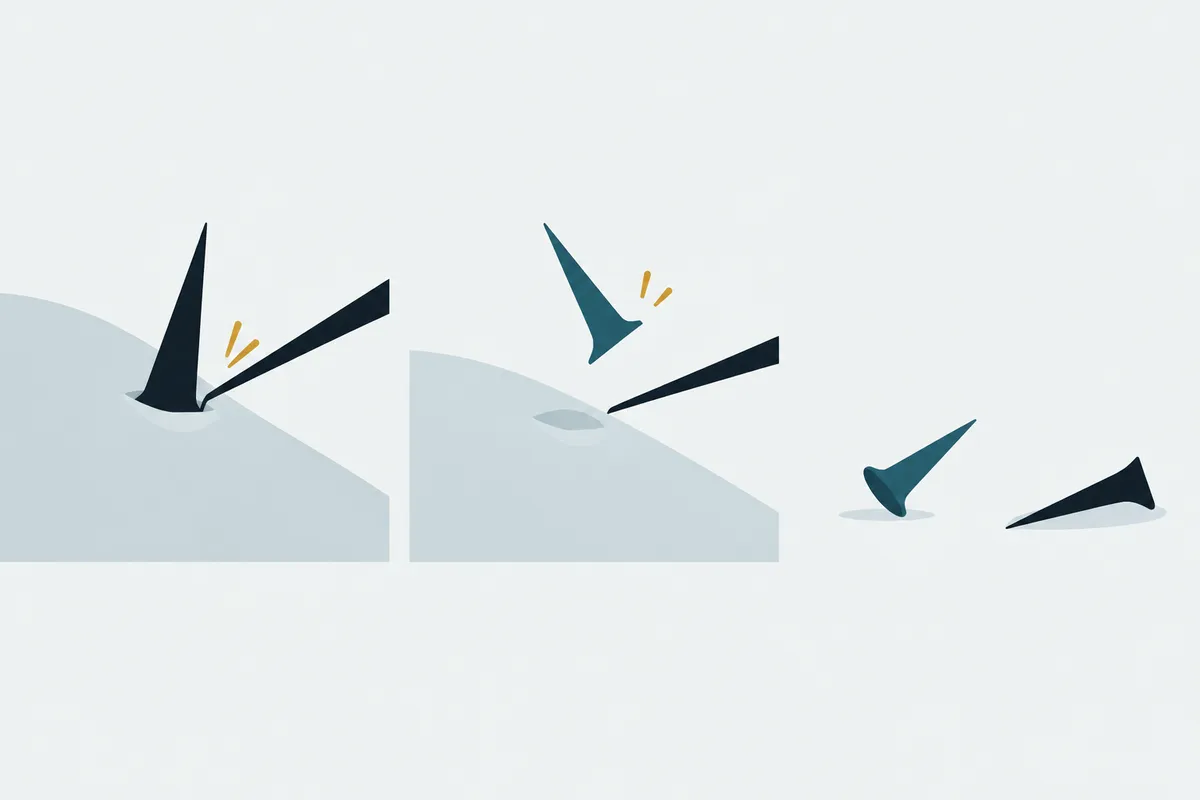
An old image: a technique is a thorn used to remove a thorn. Once the first thorn is out, you throw both away. Hold onto the technique, keep repeating it, believe it is special, and it becomes another layer of the self-structure, another control mechanism. Ramana Maharshi's warning is blunt: to let the mind run the practice is to make the thief the chief of police.
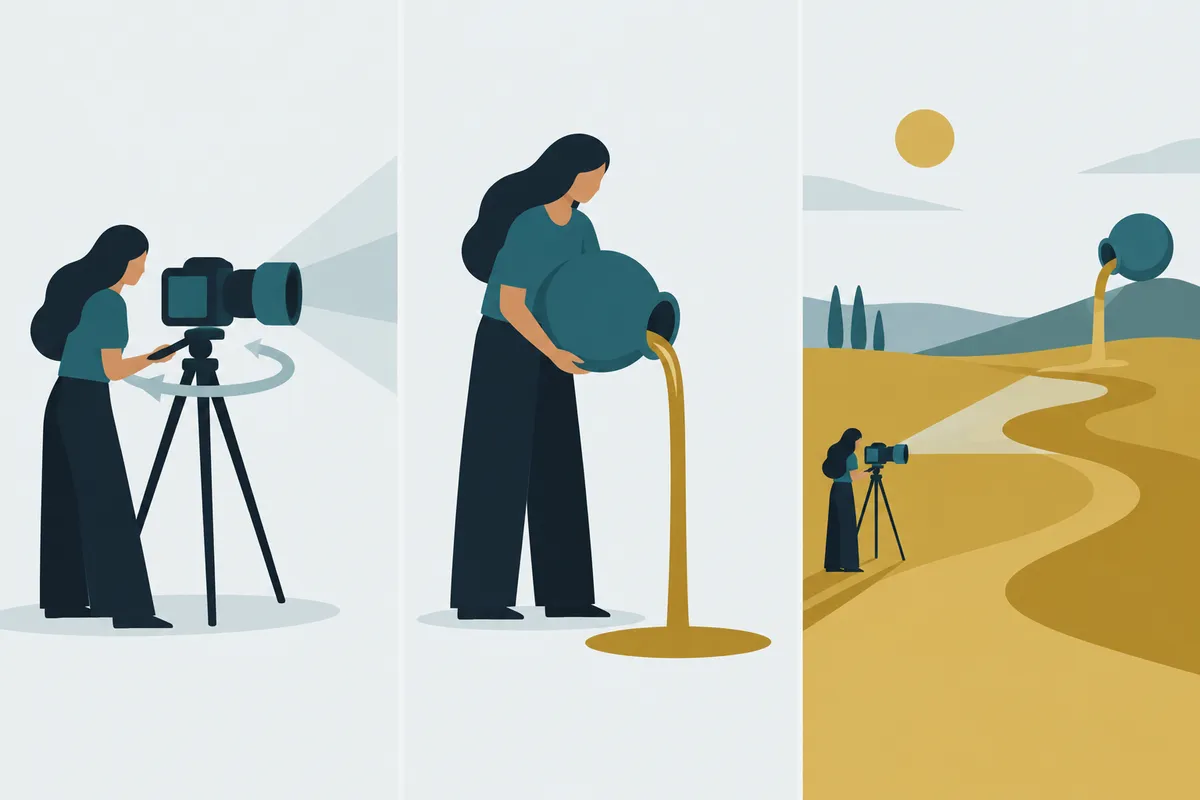
Concentration is the camera. It can be turned toward the breath, a sound, a point between the eyebrows. It can be narrow (air at the nostrils) or wide (the whole body expanding and contracting). Turning toward and setting the width: that is concentration.
Attention is the continuity of staying with the object through time. Attention span. Patanjali's image is oil poured from a jar: an unbroken stream, not drops. Concentration chooses the object; attention keeps it.
Awareness is neither. It is what the camera and its continuity appear in. It has no direction, no width and no quality; it is not something you turn or hold. Krishnamurti called it choiceless for exactly this reason: the mind chooses where to point, and awareness is simply aware of that choosing. When these pages say "rest as awareness", they never mean "point your awareness somewhere". They mean stop pointing.
In the Mahabharata, the archery master Drona sets a wooden bird in a tree and has his students take aim at its eye. As each draws the bow he asks: what do you see? One sees the bird, the tree, the other students, his own arrow. Dismissed. Another sees, in his mind's eye, the arrow entering the eye. Closer, but no. One cleverly says there is no bird. Nice try. Last comes Arjuna, and when asked what he sees he says: I see only the eye of the bird.

That is single-pointedness, and it is the key to the whole progressive path. When you take aim at your meditation object, there is nothing else. Not looking around, not reviewing how it is going, not deciding whether this is the right technique. Only the breath. The same instruction appears in St John of the Cross's ascent of Mount Carmel: climb straight up, looking neither left nor right, not stopping to pick the flowers and not frightened off by the creatures on the path. And it appears in Taoism as the reason the method works: chi follows consciousness, so when consciousness is gathered into one point, energy gathers with it, and the burning-off of conditioning begins in earnest.

It does not much matter what the object is. Breath, energy in the body, the space between the eyebrows, a chant: each is a bridge into the same field of aliveness the yogis call prana. Watch the breath long enough and you become the breath; chant long enough and you become the sound. The watcher and the watched merge. Breath is the bridge, energy is the bridge, and every road leads to the same water.
Apply single-pointed attention and surrender for more than a few minutes and the mind's defences arrive. Tiredness, a sudden need to move, an itch, doubt about the whole enterprise, a mind running scenarios like a television left on. The classic error is to treat these as things going wrong. They are the self-structure showing you exactly where it is contracted and unconscious. A hindrance is an invitation to bring consciousness to some part of your being. Even the question "how do I overcome sleepiness?" contains the mistake, because the little self that wants to overcome it is part of the sleepiness.
There are two ways to meet any hindrance, and both arrive at the same place.
Take sleepiness. It has a shape: heaviness around the eyes, a particular feeling in the head, a change in the breath, a slumping or swaying in the posture. Bring the entire pattern into view and inhabit it. How does it change over time? Is it continuous or does it come in waves? What does the breath do when it arrives? A hindrance can only take you over while it runs in the shadows. Fully seen, it becomes intimate, then it loses its power, and then it can drop. This is the phenomenological approach, and the body scan (below) is its most developed form.

Alternatively, when tiredness arises, ask: to whom does this tiredness belong? Who is tired? Clearly the mind-body is tired. But am I the mind-body? There is an awareness that is aware of the tired body; who is that? If the inquiry lands, there is an instant flip: people who were exhausted a moment before light up, because the tiredness is still there and it has nothing to do with them. This is the direct approach, and Stage 7 is devoted to it.
Which to use is a matter of intuition and of where you are on the path. The self-structure is a candle; it does not matter which end you burn.
For the mind that will not stop. Every thought is either an image (visual), an inner voice (auditory), or both. Sit with your anchor, and each time a thought pulls you away, simply note it: "visual", "auditory", or "both". Do not enter the story; do not argue with it; do not evaluate it. Note the type and return. Something surprising happens: even a heavy, frightening thought, once noted as "auditory", pops like a balloon. Repeated for a session, the technique reveals recurring patterns and drains their energy. You are using the mind to break a habit of the mind.
For samskaras held in the body. Move attention slowly and systematically through the body, part by part, head to feet and back, observing whatever sensation is present in each part with equanimity: no preference for pleasant over unpleasant, no lingering, no skipping. Where there is nothing to feel, note that too and move on. The scan brings attention to the second skandha, raw sensation, exactly where the unconscious knots are stored, and equanimity is what lets them release. It is the same principle as inhabiting a hindrance, applied to the whole body.
The invitation to sit without reacting has a limit, and it is important to know it. Productive pain is karmic: aches that only exist while sitting, the "squirm", restlessness, discomfort that is the pattern of resistance itself, held in the body and rising to be felt. The way out of it is through. Unproductive pain is the intelligence of the body reporting a real problem: an old injury, a nerve, a warning sign such as light-headedness, dry throat and vision closing in. That is not to be pushed through. Adjust the posture, use a cushion, switch to walking meditation, stop. Never brutalise the vessel.
The same distinction holds psychologically. There is a middle way between blasting through and babying yourself: move beyond the comfort zone, but not so far that the nervous system goes into overwhelm. Sweating, shaking, a sense of losing control that has no equanimity in it at all: these are signs to step back, ground the body (a barefoot walk outside works), and return when stable. Someone once asked a monk what he was doing in Las Vegas; he said anyone can be a monk on a mountain top. A noisy apartment or a difficult life is training with weights on. But weights can be too heavy, and only you can feel where that line is.
Teachers tend to fall into one of two camps. The direct-path teachers point relentlessly at the awareness that is here now, with no on-ramp: you either get it or you do not. Krishnamurti dismissed techniques altogether because it was so obvious to him that awareness is choiceless and already present. The progressive-path teachers give a method and hold that doing it faithfully leads to liberation; the Vipassana tradition of the body scan is a pure example. Both are right, and both arrive at the same samadhi.
The Buddha taught at every level, which is why his teaching has both. The famous Flower Sermon was pure direct pointing: he held up a white flower in silence, and one student in the whole assembly understood. Everyone else needed intermediary steps. Ramana Maharshi's image was of dry kindling that ignites at once versus wet wood that needs time to dry. Most people are wet wood for a while, and then are not. A reasonable approach is to work with a technique until concentration and presence are established, and then let the technique fall away into simply sitting, simply being.
The yogic term for the last three limbs of Patanjali's eightfold system, practised together, is samyama: dharana (concentration, the effortful part), dhyana (absorption, the surrendering part) and samadhi (where doing and non-doing merge). Every technique is a version of the first two, aimed at the third.
| Meditation (dhyana / vipassana) | Self-inquiry (atma-vichara) | |
|---|---|---|
| Mechanism | Observing phenomena without reaction. Cultivating concentration and equanimity to interrupt the mind-body pattern. | Turning attention toward the source of the "I"-thought. Dropping the seeker rather than training it. |
| Action when a hindrance arises | Inhabit it fully: sensation, breath, posture. Let go of the preference that it be otherwise. | Ask: to whom does this belong? Who am I, that is aware of this? |
| Energetic result | Burns up samskaras. Withdraws attention from the skandhas and frees trapped energy. | Bypasses phenomena. Can trigger an instant flip to awareness by seeing that the observer is not the mind-body. |
| Risk | Chasing states; the technique becoming part of the self-structure. | Conceptual "no-self" as a new persona; bypassing feeling. |
At depth the two are one practice. Inquire directly and every unconscious pattern surfaces to be cleared; sit with the phenomena and eventually you arrive at presence. Burning the candle from either end, or from both.
Lying down. Generally discouraged, because almost everyone falls asleep, and because sitting is what allows energy to build and break through. There is one rule in most Zen halls and it is no lying down. The exception is someone who reliably stays awake lying down and is integrating a strong energetic release; then lying can let the energy move.
Moving. If the body wants to move, ask who is moving. Sometimes it is the conditioned mind seeking relief and comfort; sometimes it is energy beginning to move the body on its own (see kriyas in the field guide). Learn to tell them apart. Dissipating the build-up through movement brings relief but never the breakthrough; there is an alchemy that happens only when the little self reaches the point where something has to give.
Noise. Explore dropping the concept of the sound ("annoying dog") and feeling the raw vibration as it arrives. If it is truly overwhelming the nervous system, use sound or ambient noise; otherwise treat it as weights on the equanimity muscle.
Controlling the breath. A little settling breathwork at the start is fine, but notice when the controller has taken over. Let the body be breathed. What happens when the one managing the breath relaxes?
Stiff hips, restless legs, a back that will not sit. Two years of ordinary stretching yoga or qigong has made the difference for many people who could not sit long enough for energy to rise. This is not spiritual; it is plumbing.
Stage 5 of 10
A seventh-century Zen poem opens with a line that contains the entire path: the Great Way is not difficult for those who have no preferences. Everything else in this stage is commentary on that sentence.
The mind divides everything into what it likes and what it dislikes, then spends its life chasing one and fleeing the other. That dividing is the disease. Not the things themselves, not the sensations, not even the thoughts: the setting of "for" against "against". Drop that, even for a moment, and the Zen poem says everything becomes clear and undisguised.
The Hsin Hsin Ming, attributed to Sengcan, the third patriarch of Zen, is a short poem on "faith in mind" (or, in some renderings, "trust in the heart"). Its diagnosis is exact. To set what you like against what you dislike is the disease of the mind. Make the smallest distinction, it says, and heaven and earth are set infinitely apart. If you wish to see the truth, hold no opinions for or against anything.
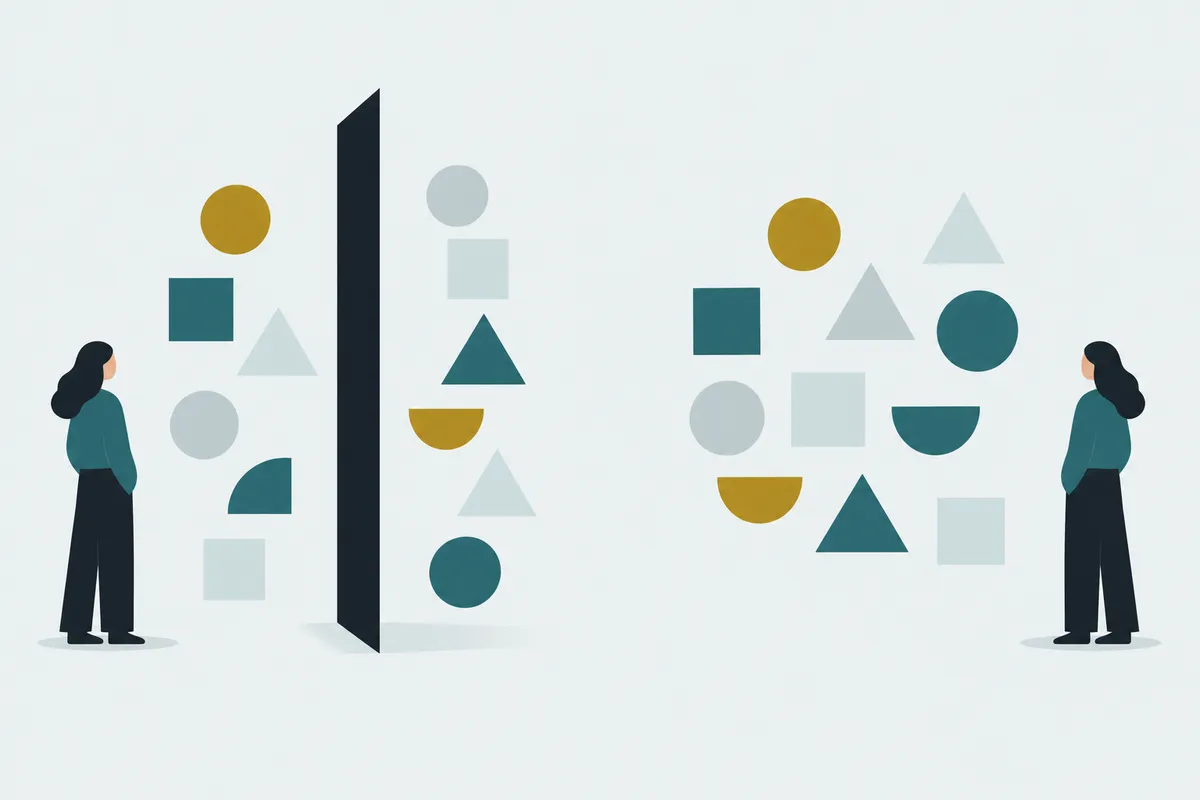
Notice what the poem does not say. It does not say stop sensing, stop thinking, or stop noticing differences. Coarse and fine, movement and rest, self and other are all allowed to appear. What ends is the reflex of grabbing one pole and pushing away the other. The poem is also careful to close the escape hatch that clever meditators reach for: trying to stop activity in order to achieve passivity, it warns, only fills you with activity. Even to be attached to the idea of enlightenment is to go astray. And most pointedly: to seek Mind (the true self, capital M) with the discriminating mind is the greatest of all mistakes. You cannot use the tool of preference to find what is prior to preference.
Read in the context of Stages 2 and 3, this is a precise instruction. The fourth skandha, the habit layer of craving and aversion, is where the "I" is thickest and where the fan gets plugged in. The Great Way is simply: stop feeding that layer. Let everything within the field of change arise and pass without dividing it into this and that.
When thought objects vanish, the thinking subject vanishes. Things are objects because of the subject; the mind is such because of things.
Hsin Hsin Ming
That couplet is the Buddhist statement of what Stage 2 called the witness and the witnessed arising together. Take away the preferring, and there is no longer a preferer. The poem ends with the phrase that names the whole project: with no preferences, "life in beginner's mind is possible", and in that mind there is no yesterday, no tomorrow, no today.
Half a world and a thousand years before Sengcan, the Tao Te Ching said the same thing in the language of nature. Heaven and earth have no preference. The highest good is like water: it benefits all things and does not compete, because it is content to settle in the low places that people despise. The most yielding thing in the world overcomes the most rigid. Thirty spokes meet at the hub, but it is the empty hole at the centre that lets the wheel turn; clay is shaped into a cup, but it is the emptiness inside that holds the water. Stillness benefits more than action, silence more than words.
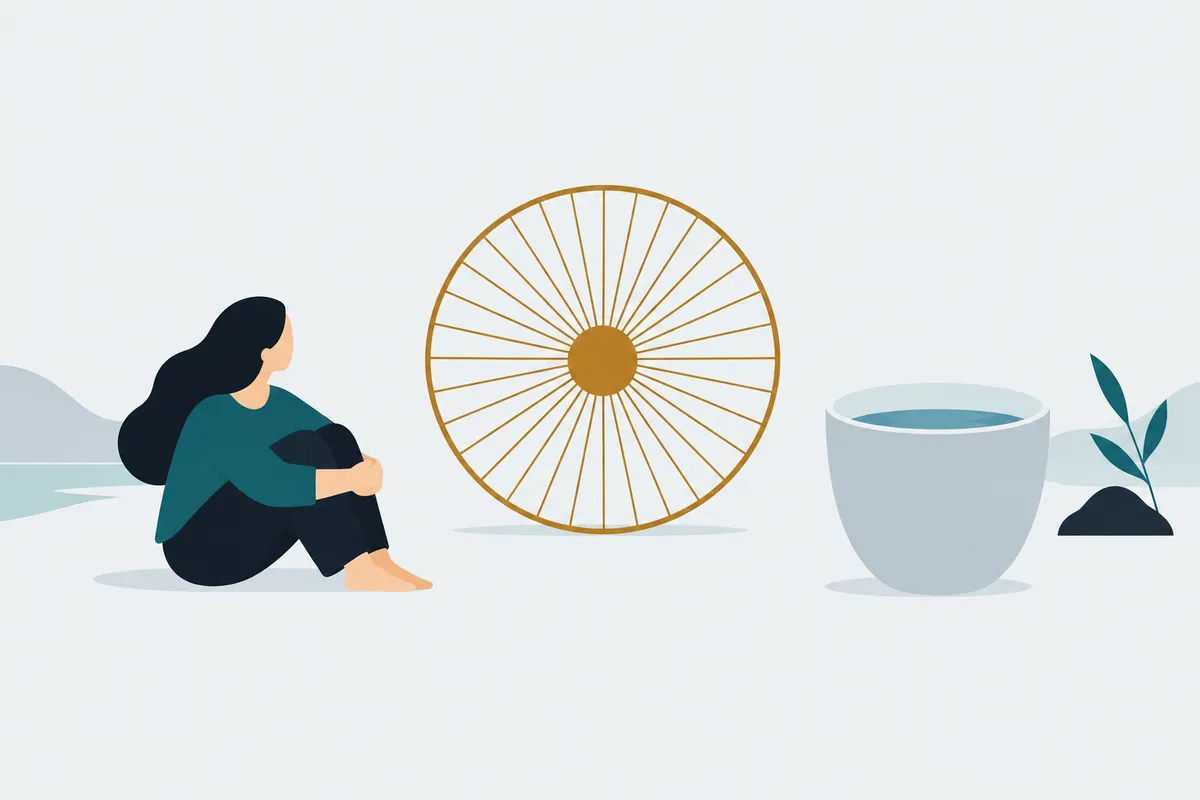
The Taoist practice that follows is wu wei, usually translated "non-action" and better understood as non-forcing. It is not passivity. Water is never passive; it is simply never in conflict with the shape of things. A mind without preferences moves the way water moves: around the rock rather than into it, always arriving at the sea. The current from Stage 1 is the Tao, and preference is the only thing that ever fights it.

A farmer in a small village owned a fine horse, and the villagers said how lucky he was. One day the horse broke out and ran off into the hills. The villagers came to console him: what bad luck. The farmer said, "Maybe. I don't know." A few days later the horse returned, leading a band of wild horses. Wonderful, said the villagers, what good fortune. "Maybe. I don't know." The farmer's son tried to tame one of the wild horses, was thrown and shattered his leg. Terrible, said the villagers. "Maybe. I don't know." The next week the king's army came through, conscripting every young man for a war, and left the boy with the broken leg behind.
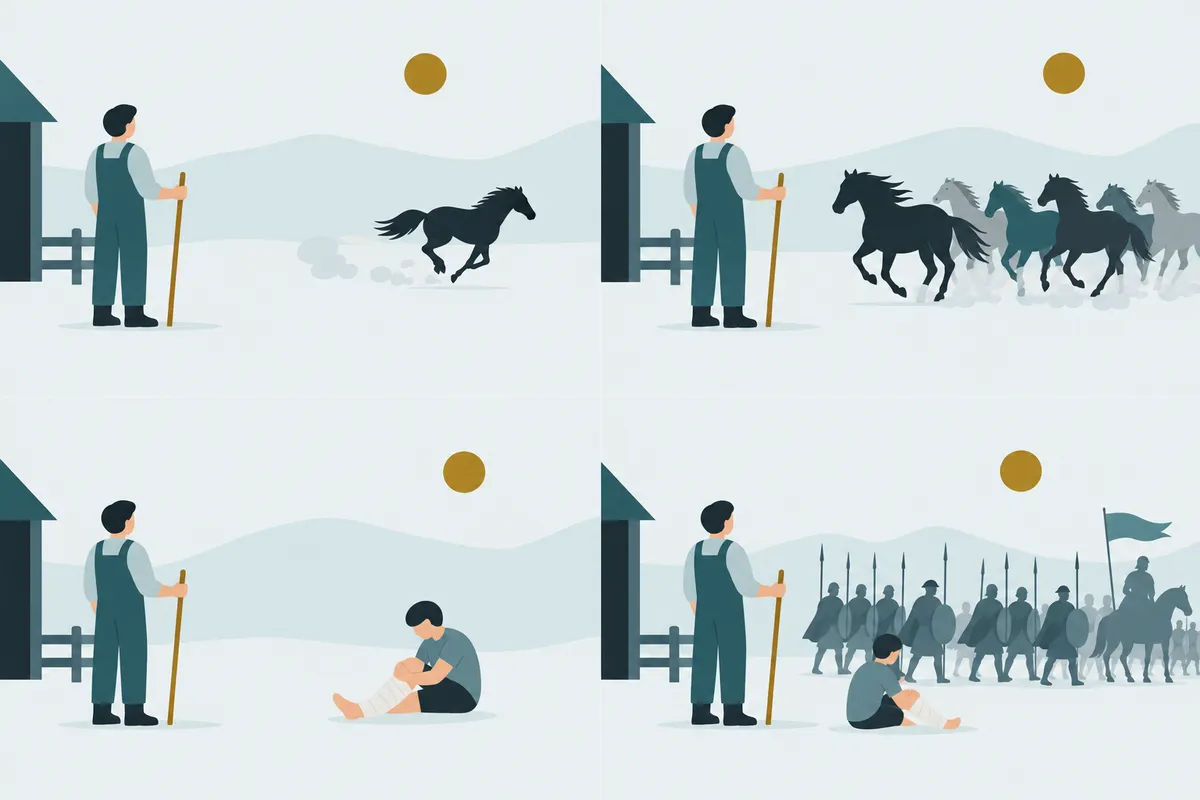
The farmer is not indifferent; he loves his son and works his land. What he has given up is the belief that the mind is qualified to judge events as good or bad. This is the "don't-know mind" that every contemplative tradition prizes, and Socrates's version was the foundation of Western philosophy: I know only that I know nothing. Applied to the villagers' running commentary in your own head, it dissolves an astonishing amount of suffering in a single word.
This question always comes, and it deserves a straight answer. The question assumes someone who knows what is evil. Every war in history has had two sides who each believed the other was the evil one. The point is not that nothing is wrong; it is that the mind's certainty about it is the same machinery of preference the poem is describing, now at the scale of nations. The Bhagavad Gita opens with exactly this dilemma. Arjuna, facing a battle against his own relatives, cannot see how to choose. Krishna, who represents the awakened Self, does not tell him which side is right. He tells him to let go of the doer: act, but without claiming the action; let awakened consciousness go into battle in your place.
Compassion is not something the character achieves by adopting a moral code. It is what remains when the illusion of separation thins, because finding out who you are is also finding out who everyone else is. Moral codes, then laws, are the facsimiles a society builds when direct contact has been lost. They are necessary in their place, but they are downstream of the thing itself. Repair the split at its root and compassion is not a rule; it is simply how life moves through an undivided vessel.
Preferences do not arrive naked. They come dressed as thoughts, and thoughts come dressed as facts. A practical bridge between "hold no opinions" and daily life is to question the thought before believing it. The four questions Byron Katie built her method around are a clean version: Is it true? Can I absolutely know it is true? How do I react, and what happens, when I believe that thought? Who would I be without it? Do this a few dozen times and a pattern emerges: believing the thought produces suffering and identification; dropping it frees energy. Eventually you know the game well enough not to believe the next thought at all, because you know where that road goes. Krishnamurti put the whole thing in seven words: "I don't mind what happens." And in four: no thoughts, no problems.
This is not a method for attacking the mind. The mind is already at war with itself; it is already the struggle and the one who appears to be struggling. Questioning a thought is not more fighting; it is withdrawing belief, which is the fuel.
Buddhism: upekkha, equanimity, is the last of the four divine abodes and the quality that makes the other three (loving-kindness, compassion, sympathetic joy) stable. The Bahiya teaching, "in the seen, only the seen; in the heard, only the heard", is the no-preference instruction in its purest form.
Taoism: wu wei and the way of water, above. The Tao Te Ching's sage "does nothing, and nothing is left undone".
Hinduism: the Gita's samatva, evenness of mind in success and failure, is called yoga itself: "Yoga is evenness of mind." Krishna praises the one who is the same toward friend and foe, praise and blame, heat and cold.
Sufism: rida, contentment with whatever God sends, and the practice of holding no complaint. Rumi's poem "The Guest House" welcomes every arrival, the dark thought and the shame alike, as a guide sent from beyond.
Christianity: "Thy will be done." The mystics call it holy indifference: Ignatius of Loyola counsels being no more attached to health than sickness, wealth than poverty, and Meister Eckhart's Gelassenheit, releasement, is letting things be as they are.
Stage 6 of 10
As sitting deepens, the mind passes through recognisable stages of absorption, and some of them are the most beautiful experiences a human being can have. That is precisely the danger. This stage maps the territory and names the one mistake almost everyone makes in it.
The Pali word jhana (Sanskrit dhyana, from which come Chan and Zen) traces back to a root meaning "to burn up". Meditation burns up conditioning, and as it burns, energy is freed and consciousness changes, layer by layer. These states are real, they are signs of progress, and none of them is who you are. Mistaking a state for your true nature is the one mistake that keeps the whole game of "I got it, I lost it" going.
Here is the general shape of the progression, held loosely. It is far better to discover these things in your own sitting than to hunt for them with a checklist.

The hindrances. At the start, the mind is a whirlpool of preference: craving, aversion, restlessness, doubt. This is dukkha, unsatisfactoriness, as a felt state. Practice here is mostly the work of Stage 4, cultivating enough equanimity that the hindrances stop being hindrances and become the way in.
Energy breaks through. When reaction to preference slows, something gives. Energy the Pali texts call piti (rapture, or simply freed prana) rises, and the felt tone shifts from struggle to ease: from dukkha to sukha, satisfactoriness. This is the first jhana, and it feels good. It can arrive as tingling, warmth, waves, light, geometric colour, sound, or a change in the state of consciousness itself.
Letting go of the good feeling. A new game begins immediately: the mind learns that this can be produced and starts preferring it. So the next thing to release is sukha itself. Anyone who plays the sensation game long enough discovers it is endless; states arise and pass, and chasing them is samsara with a nicer decor. The insight of impermanence, anicca, begins here as a felt fact rather than a doctrine. Letting the states come and go is a deeper equanimity, and another layer of mind drops.
Single-pointedness. The small waves settle. The mind becomes one-pointed, energy builds, and there is a stage, often the fourth jhana, where the part of the mind that distinguishes pain from pleasure goes quiet. People report tireless energy, as if they could sit forever. This is the end of the "material" jhanas, the ones still connected to body and sensation.
Mind and body drop away. Keep sitting and the body-mind falls off. The "immaterial" jhanas are rarely discussed because there is little point: consciousness experienced as infinite; then states the mind cannot even frame, such as "neither perception nor non-perception". Very subtle layers of self drop here. Dogen's definition of meditation, "to drop off body and mind", refers to this.
Hold all of this lightly. If it becomes a set of boxes to tick ("got the first one, second one covered"), it has become dharma as another possession of the ego. A menu describes the meal; nobody is nourished by eating the menu. The map is useful only so that when the territory appears you are not frightened, and not fooled.

The deepest of the technique-produced states is the union experience: being one with everything. In the yoga sutras it is savikalpa or sabija samadhi, samadhi "with a seed", because a seed of the self-structure survives inside it and will sprout again. In Buddhist terms it is the fruit of the material jhanas. It is temporary, as every state is. And it is the peak experience of a human life.
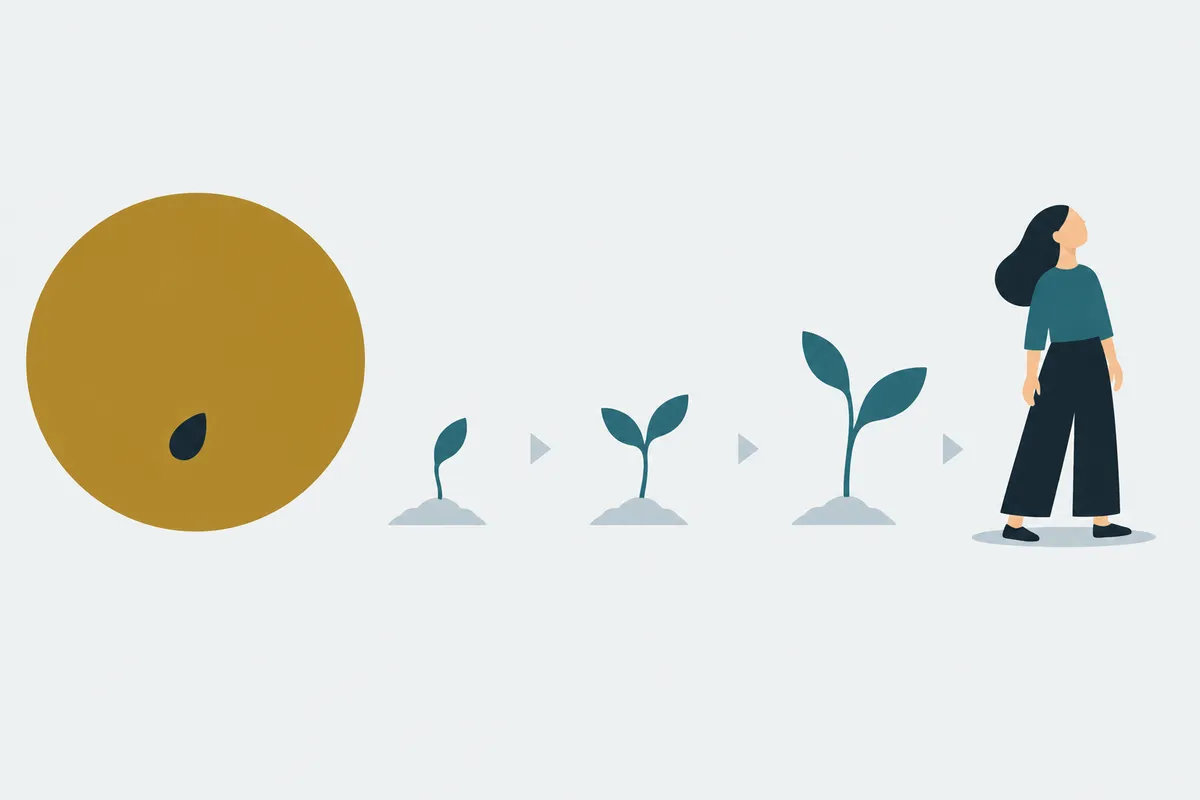
Which is why it should come with a warning. Consider a common story. A beginner at a meditation retreat, who still fully believes they are the character, has this experience. They walk out under the stars and are the stars; the tree is them; everything is them. The character thinks: this is it, this is what the Buddha and Christ had, I did it. Then, as every state does, it fades. And in the fading, the seeker is born: a desperate hunger to get it back, which drives years of sutras, techniques, teachers, retreats, and a growing pile of knowledge that only moves them further from it. The seeker finally fails, completely, in some place with no escape, having tried every trick. The mind is humbled; it realises it knows nothing about its true nature. And in that failure, with nothing left for the character to do, the conditions are right for the flip.
The lesson is not that union is bad. It is that it is far better to awaken to what you are before having the union experience, because the experience, arriving to someone who still believes they are the character, almost guarantees the creation of a seeker.
Savikalpa samadhi is the peak of the experience side of practice. A technique — breath, body scan, chant, concentration on energy — carries attention into union with its object. The breath is no longer over there; everything is you. It can be the most beautiful experience of a life, and it is temporary because it is still an experience.
One practitioner met it as a beginner during a body-scan retreat. Walking afterwards, the trees and stars were not separate from him. He thought the character had become enlightened. The state vanished in sleep, and the next morning its absence felt like a fall from the highest place to the lowest. A seeker was born and spent a decade collecting teachings and techniques to get it back. The more the character tried, the further away it seemed. Only complete failure revealed who had been struggling.
Nirvikalpa samadhi points the other way. Mind and body drop off altogether. There is no world, no sense object, no phenomenon — identical to deep sleep except that primordial awareness is awake. Nothing appears, yet there is unmistakable continuity. From this comes the unshakeable knowledge that what you are does not die; birth and death belong to form. A deep kenshō is this recognition: not merely that everything is you, but that you are none of what appears.
Kenshō may first be clear only while awake. “Full kenshō” names continuity through waking, dreaming and deep sleep. The Sanskrit map calls a taste of this turīya, the fourth that underlies the other three states. Turīyātīta, or sahaja samādhi, is its permanent, natural form. Life remains fully available: work happens, conversation happens, and there is a sense of watching the character live without being confined to it.
The distance between a glimpse and a great master is not a more impressive experience but relentlessness. Ramana Maharshi awakened and would not give the recognition up. For most people it brightens in deep practice and dims in ordinary life. The invitation is not to imitate his outer life, but to value continuity more than any state passing through it.
There is really only one mistake on this path, and it perpetuates everything else: mistaking a state, any state, for the truth of who you are. The state is phenomena. It is in time; it comes and goes; the mind can remember it, or thinks it can. What it actually remembers is the energy, the feelings, the light, the sense of expansion. It cannot remember the awareness that was present, because awareness is not an experience. It is what the experience appeared in, and it is here now, unchanged, while you read this sentence.
So when the mind says "I had it and I lost it", ask what "it" was. If it was the beautiful phenomena, then yes: gone, as all phenomena go. But the one who knew the phenomena was not part of the phenomena. The awareness in the peak experience is the awareness here now. Nothing about it has changed; only the show around it changed. Recognise that, and there is nothing to get back.
Picture the whole of human experience as a line. At one end, total union, love, bliss. At the other, total identification, separation, hell. Every moment of a life is somewhere on that line. Who experiences the entire line? That one is what these stages are trying to reveal, and it is not at either end. When identity flips from the character travelling the line to the awareness the line appears in, there is a peace that is not contingent on where the character currently is. It is not the joy at the happy end of the line. It is something of a different order: the relief of knowing what you are.
A Zen student sat with great diligence, following every rule and working hard to become enlightened. One day his teacher sat down beside him with a flat stone tile and began rubbing it. The student tried to keep meditating, but at last asked what the teacher was doing. “Polishing this tile to make a mirror.” The student stared. A stone can be polished all day and will never become a mirror. The teacher’s reply was the lesson: that is what you are doing with the conditioned self.
The self-structure is the tile. It can become calmer, kinder, better informed and exquisitely spiritual, but no amount of improvement turns it into awareness. When practice becomes a project by which “I” will awaken, the tile is polishing itself. The effort may prepare the ground, yet the one claiming the effort cannot cross the last step.
The teacher keeps polishing until the student's project is exposed as impossible.
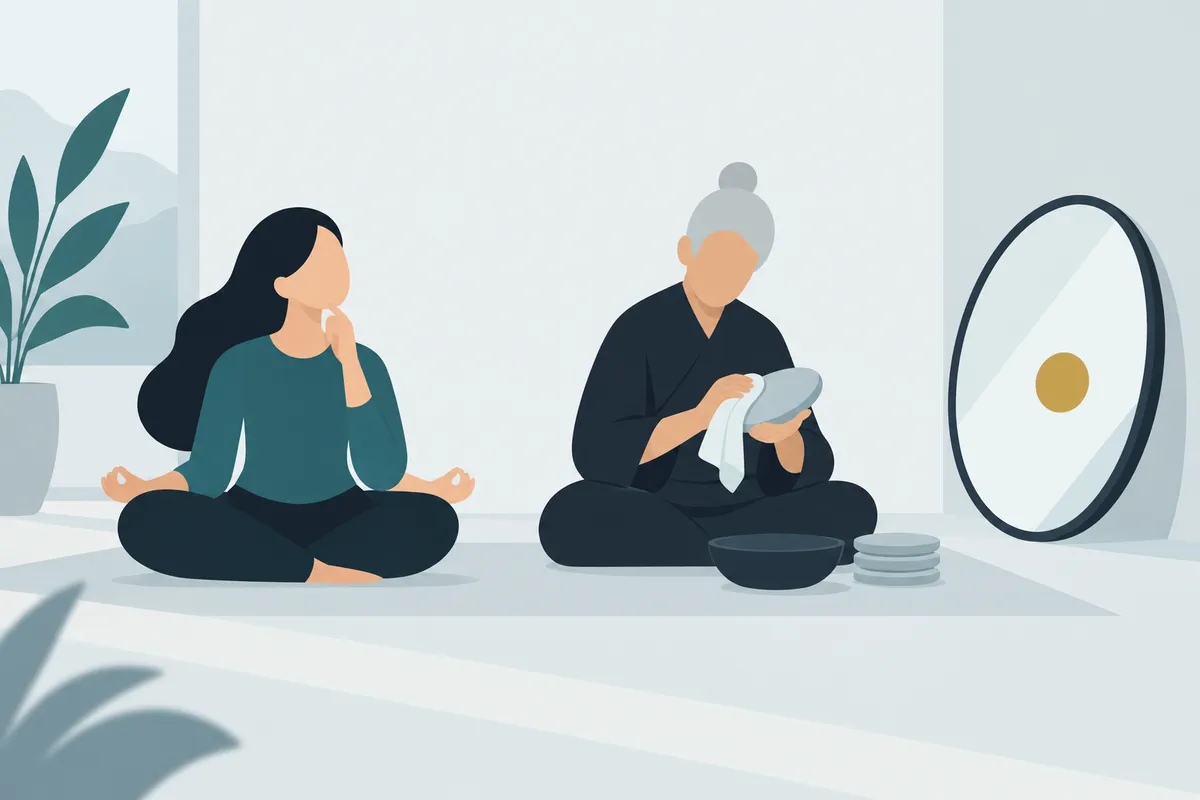
So let the mud settle. Do not stir the water in order to make it clear. Sit without adding another task, another judgement or another picture of success. This is just being: not passivity, and not a special state produced by the mind. As the whirlpool slows, recognise who is aware of the stillness. The mirror was never manufactured by the tile. It is what has known the polishing, the confusion and the quiet from the beginning.
Patanjali divides samadhi into stages that map onto the Buddhist jhanas with roughly ninety percent agreement, which is remarkable for two systems that developed separately. The first four jhanas, the material absorptions, correspond to samadhi with seed. Beyond them, Patanjali names nirvikalpa or nirbija samadhi: seedless, without support, in which the mind-body structure drops off entirely and no seed remains to regrow. The yogic word for the last of his eight limbs, samadhi, is the goal of the seventh, dhyana, which is the same word as jhana and Zen.
| Stage | What is present | What drops |
|---|---|---|
| Before absorption | The five hindrances: sense desire, ill will, sloth, restlessness, doubt. | Nothing yet. Equanimity is being built. |
| First jhana | Applied and sustained attention, rapture (piti), happiness (sukha), one-pointedness. | The hindrances, and the felt tone of dukkha. |
| Second jhana | Rapture, happiness, one-pointedness; inner confidence. | Discursive thinking about the object. |
| Third jhana | Happiness, equanimity, mindfulness. | Rapture, the coarser excitement of energy. |
| Fourth jhana | Pure equanimity and one-pointedness; tireless energy. | The preference for pleasure over pain. |
| Immaterial jhanas | Infinite space; infinite consciousness; nothingness; neither perception nor non-perception. | Body, then the subtlest structures of mind. |
The table is for orientation, not for scoring. Different systems divide the phenomena differently, and your own sitting will not follow anyone's diagram exactly. It unfolds by itself when you are simply present.
Sufism describes the union state as fana, annihilation of the self in God, and is equally clear that it is not the end: baqa, subsistence, is the return to ordinary life with the self gone and God remaining. Al-Hallaj's "I am the Truth" was spoken from fana; the tradition remembers both his ecstasy and the price of announcing it.
Christian mysticism has a large literature of "consolations", the sweetnesses that visit the contemplative, and an equally large literature warning against attachment to them. St John of the Cross's dark night is, in part, the withdrawal of consolations so that the soul stops loving the gifts and learns to love the giver. Teresa of Ávila's interior castle moves through mansions of increasing absorption toward a union that is not a passing rapture but a settled marriage.
Hinduism: the Gita distinguishes the yogi who merely tastes samadhi from the one established in it (sthitaprajna, of steady wisdom), whose peace is not disturbed by the arrival or departure of any state. Ramana Maharshi called the temporary absorptions kevala and the permanent, open-eyed state sahaja, the natural state.
Taoism is suspicious of peak states on principle: the sage is ordinary, "like an uncarved block". Where the other traditions warn against clinging to the summit, Taoism quietly declines to climb it.
Stage 7 of 10
The stages so far have described the mechanism from the outside. Direct inquiry goes in through the front door: it turns attention toward the one who is asking, and lets the mind fail to find an answer. The silence where the answer should be is the point.
Every thought, feeling and sensation is something you are aware of. Inquiry asks what is aware. The mind cannot answer, because every answer it produces is one more thing you are aware of. When the mind is finally humbled, when it stops producing candidates and gives up, what remains is not an answer but a direct experience. This is the only game you win by giving up.
Look at what the word "I" actually points to when it arises in you. It is attached to a body, a name, a set of preferences, a history. Ramana Maharshi's whole teaching rested on tracing this "I"-thought back to its source: not the "I" that says "I want" or "I am tired", but what that "I" is standing on. His instruction was to ask who am I?, not as a question expecting words but as a turning of attention toward the asker.
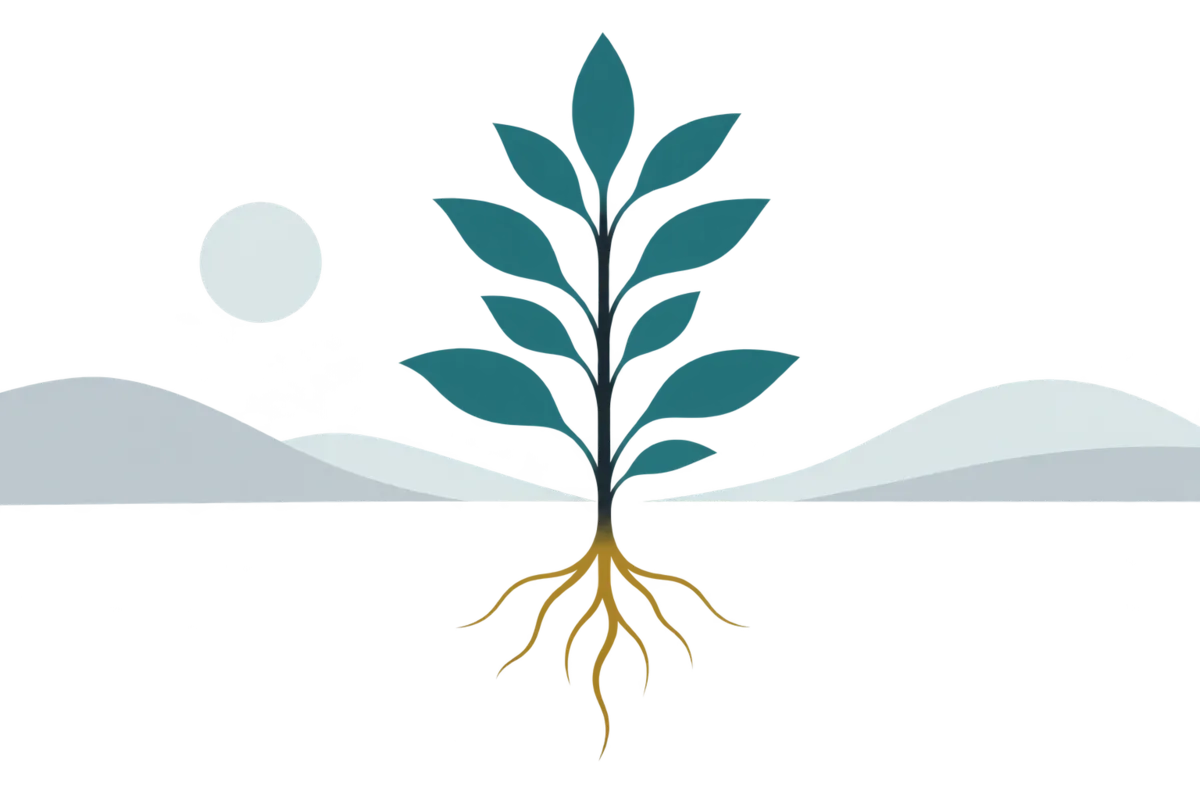
A working definition that makes inquiry sharper: the I-thought is the resistance to what is. In any moment there are thoughts, sensations, perceptions, arising and passing. If there is a preference inside any of it, a "this should be otherwise", that is the I-thought. Everything else is just the show. So the inquiry is not "which of these experiences is me?" but "who is the one resisting?", and then, "who is aware of that one?"
Do not expect to figure it out. The distinction between the false "I" and the true is not something a third "I" works out by analysis. It is a stripping away. Identification dissolves, and with it the question. When the questioning mind drops, there is no residue of doubt, and nothing to distinguish.
A structured form of inquiry, developed in the 1960s and since used in intensive retreats around the world, does the inquiry in pairs and can produce awakening (kensho) with surprising speed. It is called the dyad. It works because saying what arises, out loud, to a neutral witness, makes unconscious resistance visible in a way that solitary sitting often does not.
Two people sit facing each other. One is the witness; the other is the inquirer. The witness delivers the instruction: Tell me who you are. This is not a question. It is an imperative, a command to communicate yourself, with your whole being, not with a definition. The inquirer then does three things at once:

The witness does nothing. No nodding, no "mm-hmm", no facial commentary, no advice, no prompting. Pure neutral presence, receiving. After five minutes, the roles swap. That is the whole technique.
What happens in practice is that the mind searches for an answer and reports everything it finds: "I'm a mother", "I'm tired", "I'm awareness" (a concept), "I don't know", "this is pointless". Each report is a piece of the self-structure being cleared, spoken and released. Doing it, people are also told to scrutinise every "I", "me" and "my" they say, to see whether the word is referring to the character or to what is aware of the character. Eventually the mind runs out. The search fails. And in the failure, the inquirer is simply here, wordlessly conveying what they are to another human being. Some meet themselves for the first time in that moment.
This is the only game you win by giving up. You give up control, you give up knowing, you surrender, and in the stillness of the surrender you experience the truth.
On the dyad
Two kinds of trouble arise reliably in inquiry, and they are the same trouble.
The first is striving. The question becomes a torment: I must find out who I am, I cannot be happy until I do, and time is running out. Notice that the striving is the movement of the mind, wanting something other than what is, and the mind does not even know what it wants. That striving is exactly what must relax for stillness to be there. The relief when it finally does is enormous, and it is the relief of discovering that what was being sought was here the whole time. If sitting quietly and being present is easy but the question makes you tense, then be present, and look at who is present. That is the inquiry.
The second is the gap. Someone who had a glimpse years ago says: I recognise awareness now, but it does not feel like it did then; there is a gap and I am trying to cross it. There is no gap. The mind remembers the phenomena that accompanied the glimpse, and is comparing this moment's phenomena unfavourably. The awareness in the glimpse and the awareness reading this are one and the same. Let the memory go, and there is nothing to cross.
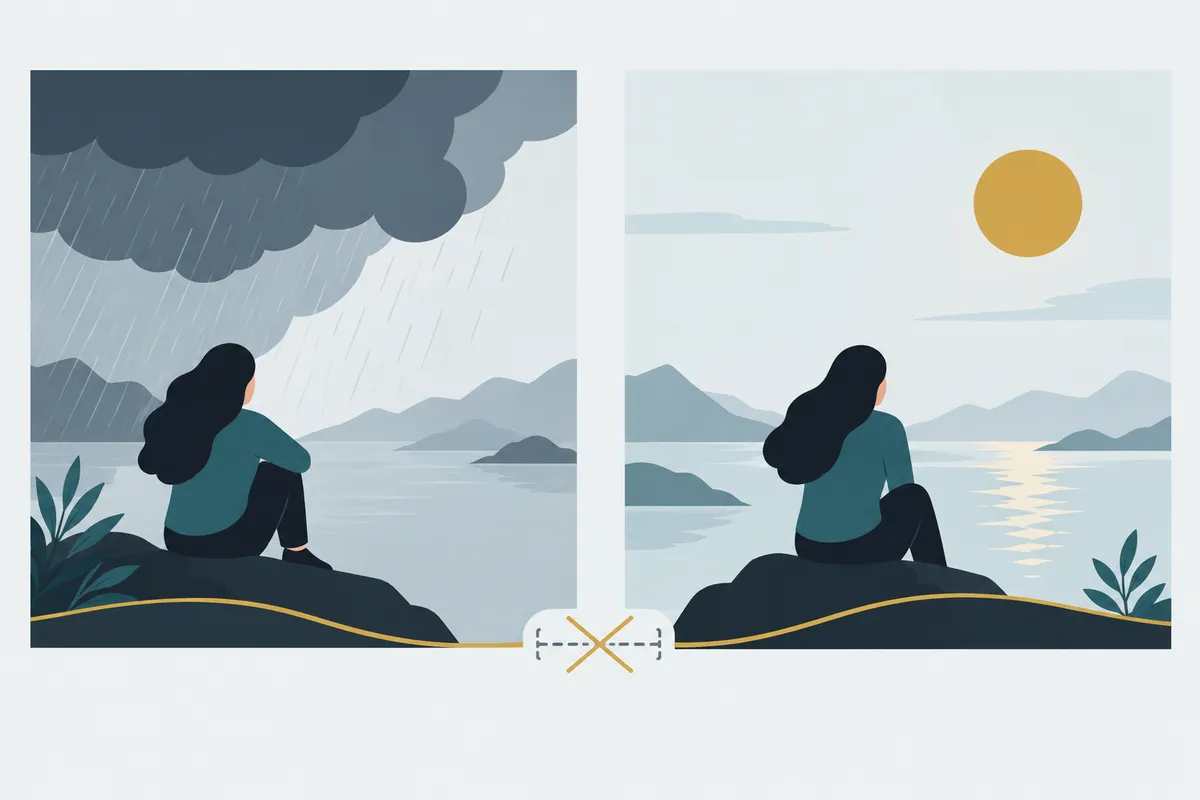
Both troubles resolve when the mind learns the one thing it has to learn in this whole process: its own limitation. It cannot do this. Its actions in this domain are futile, all of them. Once it truly gets that, seeking ends, not by force but by the seeker seeing its own irrelevance. And being, which was never absent, is obvious.
Self-inquiry is difficult because it is so simple. There is nothing useful for the thinking mind to do. Everything it finds inside the self-structure — a memory, state, answer, watcher or spiritual identity — is still the false self. If it changes or can be observed, keep going. If it is not here now, it is not the true Self.
Recognition is more like seeing an uncle behind Santa’s slipping beard than acquiring an experience. Once the disguise is seen, you cannot honestly unsee it. Until then, enter the “don’t-know” mind all the way down, including the unconscious places that quietly insist they already know. St John of the Cross wrote, “To come to the knowledge you have not, you must go by the way you know not.” T. S. Eliot gives the same instruction:
I said to my soul, be still, and wait without hope
T. S. Eliot, East Coker
For hope would be hope for the wrong thing.
Ramana Maharshi’s practical version is to hold the feeling of “I” until the false “I” vanishes, leaving unbroken awareness. This beginner’s mind, shoshin, is not merely fresh curiosity. It is the primordial mind before the skandhas seize and organise experience, and it carries an energy of its own.
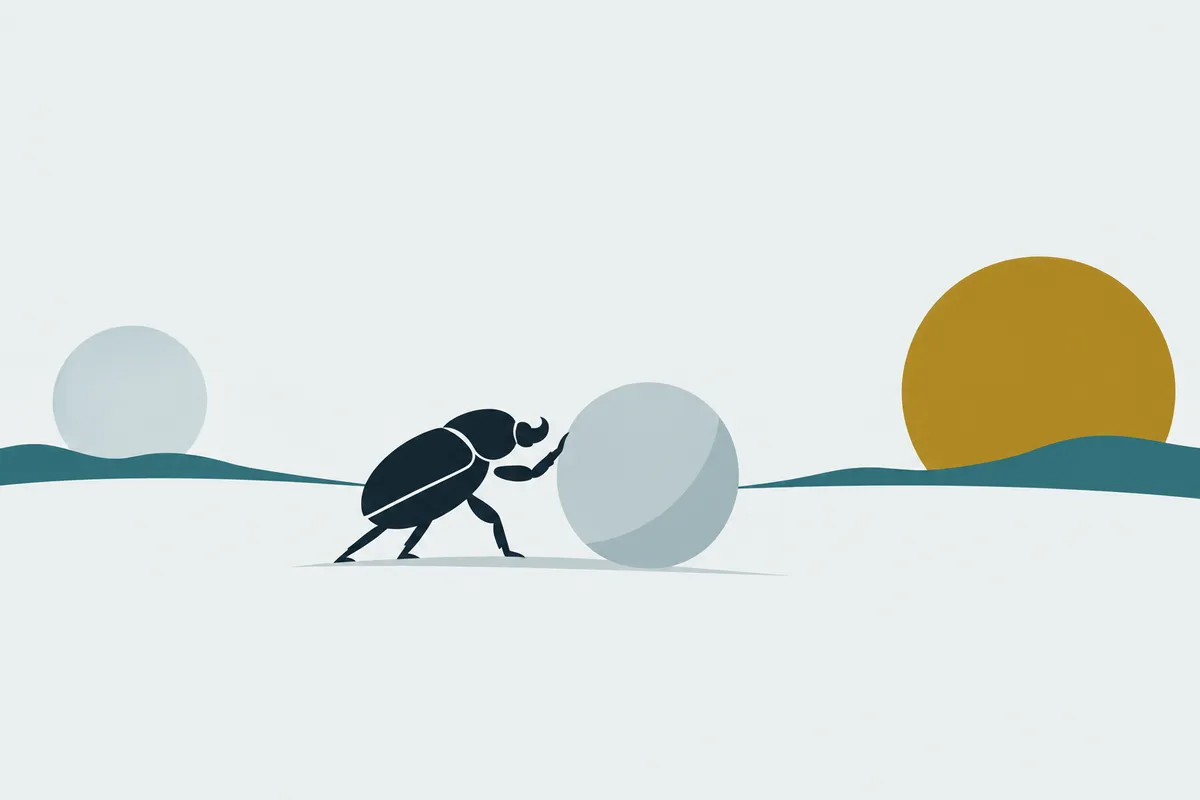
The Egyptian scarab, khepri, gives that energy a body. The beetle rolls its ball away from the moon — the conditioned mind, shining with borrowed light — towards the sun. Initiates were themselves called khepri: the evolutionary force that brought you to this work was already moving before the little mind asked, “How do I do it?” That question is how the mind co-opts the force and turns it into seeking.
The scarab keeps rolling without needing a theory of the sun.
The ouroboros, a snake eating its tail, shows the result of that co-option: the seeker chases itself like a cat spinning after its own tail. Nature moves differently. A dragonfly works free; a butterfly dissolves and reforms through effortless effort. The ego would rather become “a caterpillar with wings” than surrender to an intelligence it cannot manage.
The mind cannot choose choiceless awareness; that is like planning to be spontaneous. Let the primordial movement move. As Zen puts it, “if you want stillness, let yourself go into the moving stream”. The river from the beginning of this path has been carrying you all along.
No prompting. An untrained witness who starts guiding ("but tell me who you are, tell me about awareness") breaks the technique. Prompting is a skill for facilitators who have themselves awakened and are clear. Between friends or partners, hold pure neutrality and let the imperative do the work. The technique works without any facilitator at all.
Clearing before answering. If what arises is dark, frightening or "not spiritual", that is precisely what to report. The dyad is a clearing process first. What blocks the direct experience must surface and be spoken before the experience is available. An inquirer who feels a demon-like energy arise and reports it is doing it right; a witness who says "no, tell me about awareness" is not.
Weather reports. Reporting "my knee itches, a car went by, I feel neutral" for five minutes is the mind on a loop. Feel the frustration and pointlessness of that, report that, and look for what is being held just under the surface. Go toward feeling, not analysis, almost like a child playing.
With a spouse. Dyads between partners can be beautiful and can be volatile, because the character has twenty years of material with this particular witness. Keep the roles strict, keep the witness silent, and treat what comes up as clearing, not as a conversation to continue afterwards.
Solo. Without a partner, sit and receive the imperative from yourself, or simply become aware of being. Intend to directly experience; notice what arises; let it be fully felt and cleared; return. It is the same process without the mirror.
Advaita Vedanta: atma-vichara, self-inquiry, is Ramana Maharshi's method and the heart of the Upanishads' "neti, neti" (not this, not this): every object that can be known is set aside until only the knower remains. The Kena Upanishad asks by whose will the mind moves, and answers that it is what the mind cannot think but by which the mind thinks.
Zen: the koan is inquiry given an impossible object. "What was your original face before your parents were born?" is functionally "tell me who you are". The Zen master Bassui's instruction was simply to ask, at every moment, "who is hearing this sound?" Hakuin insisted that the failure of the intellect, the "great doubt", is the door.
Sufism: "He who knows himself knows his Lord", a saying the Sufis treat as the root of the path. The practice of dhikr, remembrance, turns attention from the world to the One until the rememberer disappears into the remembering.
Christianity: "Be still, and know that I am God" (Psalm 46:10) is read by contemplatives as instruction rather than reassurance: still the mind, and know the I AM. The name given to Moses at the burning bush, "I AM THAT I AM", and Jesus's "before Abraham was, I am", are the traditions' pointers to the same awareness inquiry uncovers. The anonymous Cloud of Unknowing teaches that God is reached by love in a cloud where knowing has been given up, which is the mind's failure made into a method.
Kabbalah: the unpronounceable four-letter Name is a form of the verb "to be". The tradition guards it because the I AM is not an object to be named but the ground doing the naming.
Stage 8 of 10
At a certain depth the work stops being pleasant. The self-structure, feeling its grip loosen, produces a fear that seems to have no object. This is not a sign that something has gone wrong. It is the sign that inquiry has reached the root.
Fear is contracted life energy. When the little self relaxes its grip, the same energy that was fear becomes aliveness; nothing is added or removed. The path does not go around the dark parts of the psyche; it goes through them, and the hero's task in every mythology is not to slay the dragon but to ride it.
Practitioners who reach this point describe the same thing: a fear that is not of anything. Not fear of a snake or a deadline, but fear itself, a feeling of not being in control, of imminent dissolution. The mind rushes to supply objects: I will go mad, I will faint, I will lose my family, I will end up homeless, I will die. None of these is the fear. They are stories the mind wraps around a sensation it cannot explain.
What is actually happening is that the "I"-thought is giving way. Teachers who have taken students through this consider it good news: it means the work is correct and has reached the depths. Nobody gets an easy ride at the root of the self-structure. When it gets real, it gets real. And the moment fear of this kind arises is the single best moment to inquire: to whom does this fear belong? Who is watching this character go through its letting-go?
It helps to reassure the character. What feels like death is not death. The conditioned self is moving from the driver's seat to the back seat. It will still be part of the team; it will still get to play. Over time it discovers that what comes through when it stops steering is better than anything it could do alone: less predictable, more alive. The phrase "die before you die" is ancient and accurate, but it frightens the character, so it is worth translating: let go of control before your body dies, and see what is left.
Consider what happens on a large roller coaster. Climbing the first hill, you can feel fear building in the body. There are two ways to ride. In the first, at the top, something flips: you become the witness, the emptiness riding the coaster, watching the drama from a remove. It is peaceful, and it is not really riding. In the second, something gives way entirely: every sense opens, the energy opens, the emptiness is still there but so is all of the fullness, and the ride is life itself riding, connected to the whole park. Emptiness riding is a real stage. Non-dual riding is where it is going: form and emptiness together, fear and aliveness revealed as one energy.

If you hold on, the energy contracts and there is only survival. If you let go, the identical energy is bliss. It is the same with cold water: plunge in tense and it is shock; let go into it and, in time, the nervous system learns that the shock was the resistance. Practitioners who have been through the primordial fear many times report that the same energetic movement that once terrified them now simply passes through as bliss. The body learns that letting go does not mean oblivion.
Fear cannot be dropped on its own, because it is half of a pair. Hope is craving projected into the future (may this happen); fear is aversion projected into the future (may this not happen). They are the fourth skandha, wearing two masks. The "I"-thought is strongest exactly here, in hoping and fearing, and this is not a flaw in the design; it is the pulse of expansion and contraction that runs through everything, the in-breath and out-breath, yin and yang, Shiva and Shakti.

Over the gate of hell in Dante's Inferno are the words "abandon all hope, you who enter here". Read as instruction rather than threat, it is exact. Hell is the ego structure. To get through it you abandon hope, and you abandon fear, because they are the same mechanism. What is left when both are gone is not despair. It is presence. Seen clearly, fear is like the Wizard of Oz: a terrifying facade with nothing behind the curtain. Or the classic snake in the rope: frightening until you see it is a rope, and then there is nothing to be frightened of, and there never was.
Joseph Campbell, who spent his life mapping the hero's journey across cultures, summarised its turning point in one sentence: where we had thought to find an abomination, we shall find a god; where we had thought to slay another, we shall slay ourselves; where we had thought to travel outward, we shall come to the centre of our own existence.
The clearest modern telling is in the first Star Wars trilogy. Luke, training with Yoda, is sent into a dark cave. Yoda tells him he will not need his weapon. He takes it anyway, meets Darth Vader, strikes him down, and the mask falls open to show Luke's own face. Every real journey has this scene. The thing you feared most in the dark turns out to be a disowned part of you.
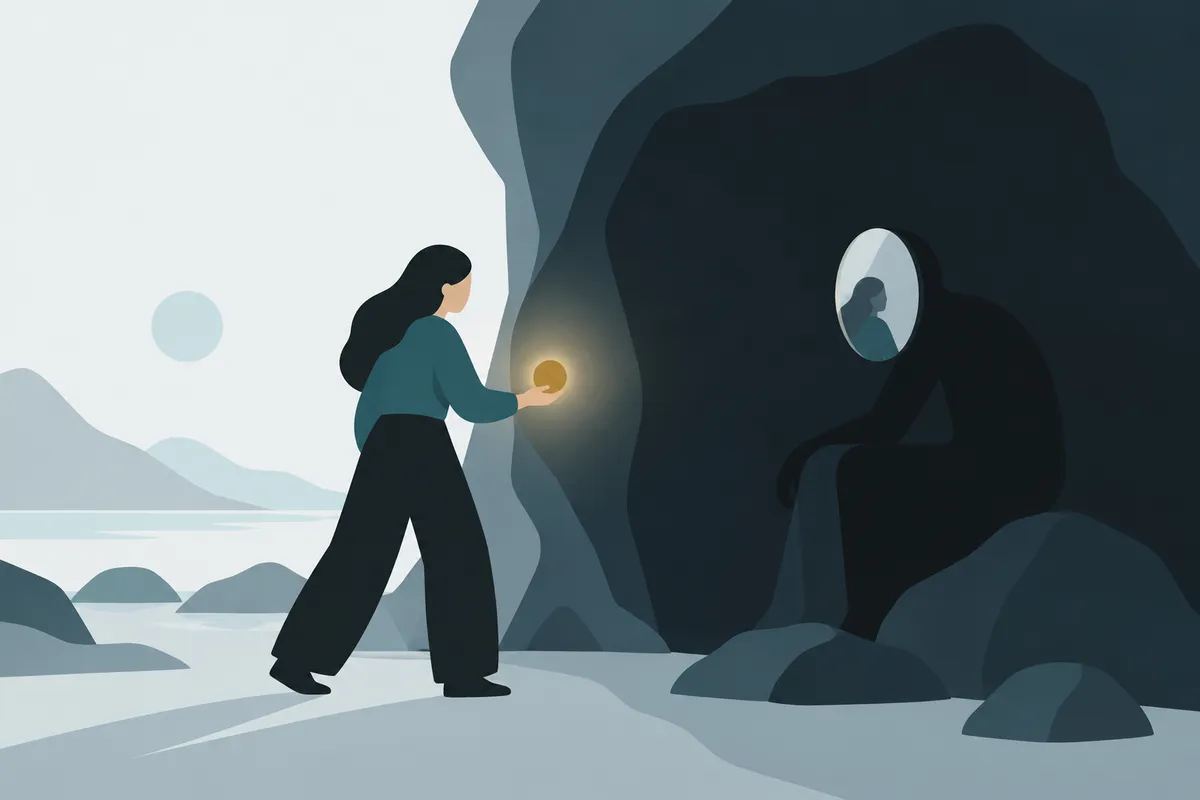
Carl Jung called these disowned parts the shadow, and he was unambiguous about the direction of the work: "One does not become enlightened by imagining figures of light, but by making the darkness conscious." And: the hero's main feat is to overcome the monster of darkness, "the long hoped-for triumph of consciousness over the unconscious". Much of modern spirituality is about imagining figures of light. It does not work, because whatever is left unconscious continues to run, and we call the results fate, or karma. Make it conscious and it is simply part of you.
Our stories have regressed. The old myths knew the dragon must be integrated; the new ones mostly have it slain, light conquering dark, good conquering evil. Look at the oldest images of the Buddha, or of Patanjali, in the ancient temples: they sit surrounded by nagas, serpents, sometimes seven of them fanning out behind the awakened one. The serpents are not being fought. They are the dimensions of the unconscious, integrated, at attention, part of the whole. Modern iconography dropped them, and something was lost.
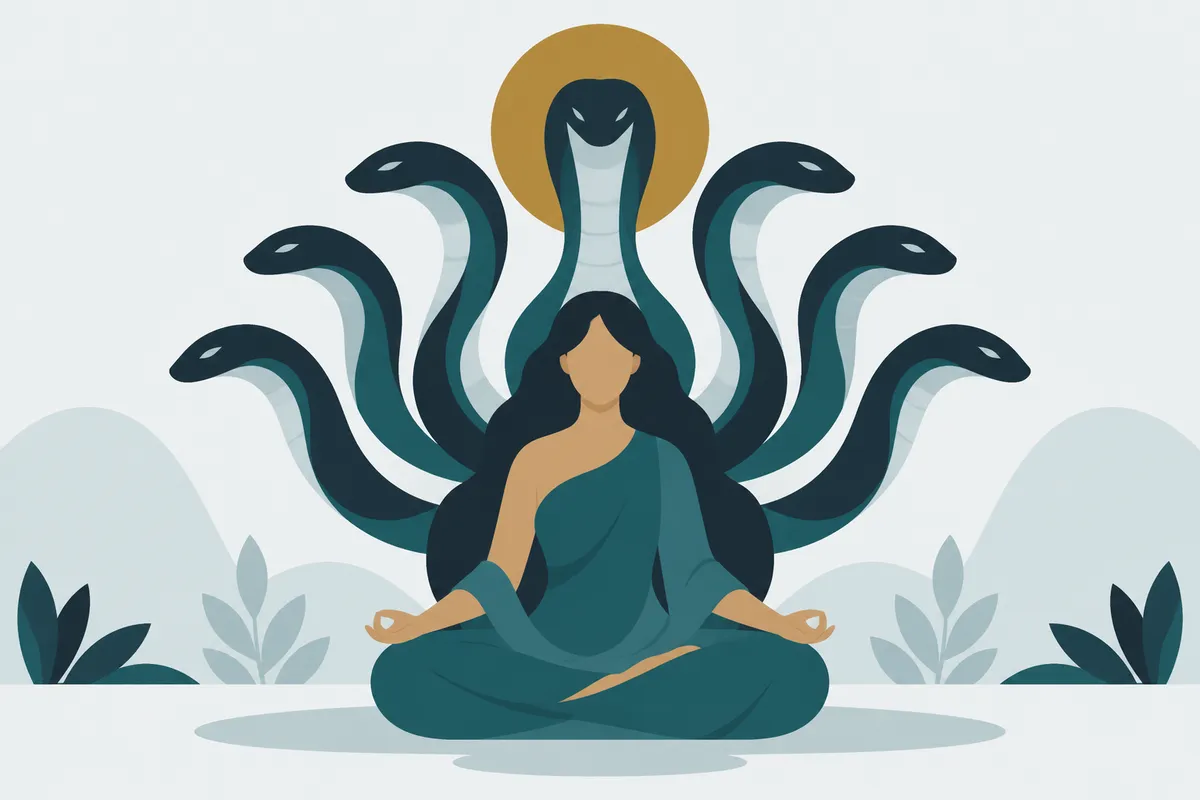
The serpent has been demonised for two thousand years: the spiral, the feminine, the manifested world, the power of becoming. Wars have been fought and people burned out of fear of it. But that power is simply nature, life itself, and only the ego ever goes to war with it. The story of the fall makes sense read this way: Lucifer, the most beautiful angel, splits off, "rather to rule in hell than serve in heaven". That is the ego, exactly: my will, not Thine, as if they were two. The fallen angel is the angel that became an ego. The demon and the angel are one energy; reject the demon and you have rejected the angel too.
This is why the shadow returns in relationships, synchronicities and triggers. Whatever you push away in yourself shows up in the world as a mirror. The person who repels you is showing you an exile. Integration does not mean acting the shadow out, and it does not mean befriending everyone who carries it. It means noticing what in yourself is being resisted, feeling it fully, and letting it come back into the one.
The Bhagavad Gita pictures the person as a chariot: the horses are the senses and desires, the reins the mind, the charioteer the discerning intelligence, and the passenger the Self. Plato's Phaedrus has a sharper version with two horses. The black horse, eros, pulls down toward the material, toward sensation and pleasure and the world. The white horse, thumos, pulls upward toward the spiritual, toward truth, toward what is higher. The charioteer must drive both.
The teaching is in what Plato does not say. He does not say kill the black horse. Kill it and you have lost half your power; the chariot cannot move. Let the white horse run unchecked and you neglect the body and the world, and the chariot goes off the road just as surely. The horses are the skandhas, and energy follows consciousness: make them conscious, harness both, and the chariot goes where the current is going. The material and the spiritual are not enemies. They are the team.
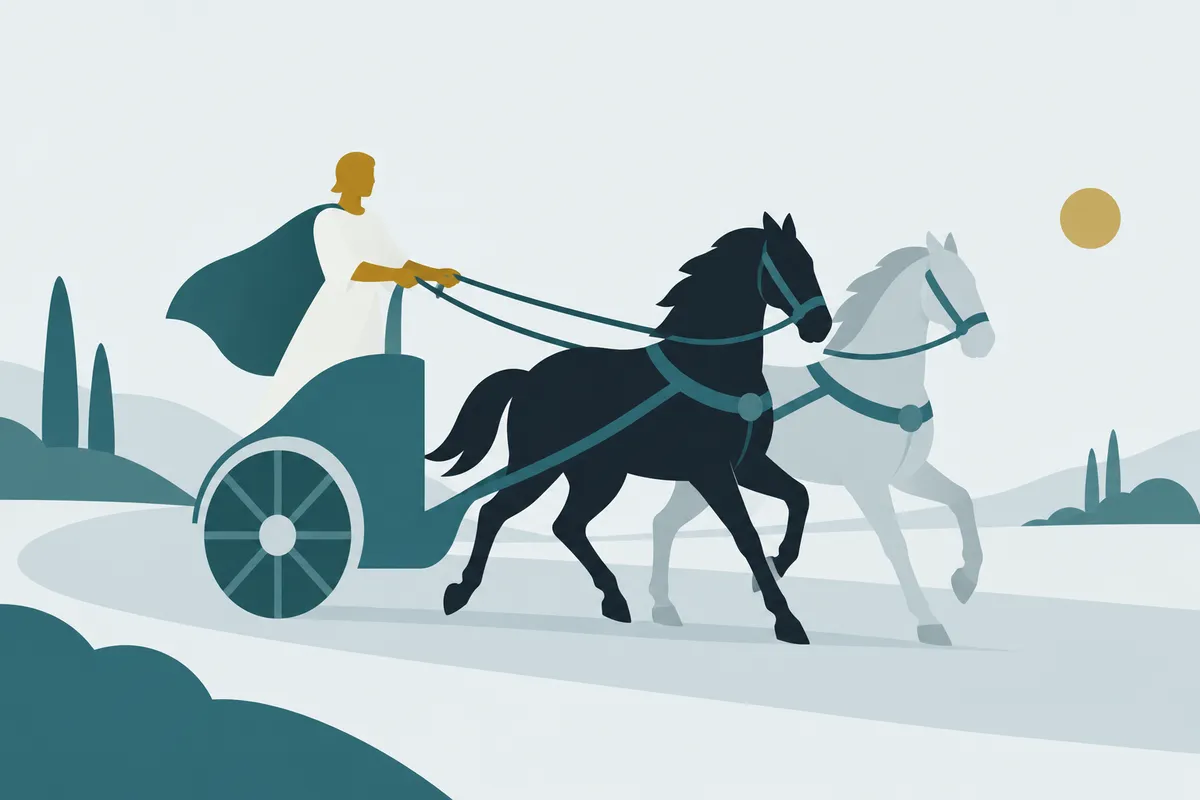
Not everyone feels this, and it is not required, but for those who do the pattern is consistent. The habitual centre of "I" sits around the brow, the third eye. As practice deepens, energy moves up from there toward the crown, and the sense of "I" has to give way for that movement to complete. If the little "I" is clinging, that is the moment fear arrives. With repetition, the same movement becomes a small, blissful event rather than a terror. Kundalini teachings describe this as the awakening of evolutionary potential through the body's centres, the chakras; the crown is where the personal current rejoins the whole.
Some traditions use literal darkness. A darkness retreat, several days without sun or moon, removes the circadian control mechanisms of duality. After three or four days something changes; the body may release its own visionary chemistry, and there is no longer dark and light but, in the words of those who have done it, only luminous emptiness, a waking dream that goes on forever. It is the cave, taken literally.
Jung also spoke of the collective unconscious. In deep clearing, what surfaces sometimes does not feel personal: generational, archetypal, like a primordial scream from something larger. Birth experiences, death experiences, huge reconfigurations of energy. The honest position is not to know what it is, and to trust that there is an intelligence to it. Grounding helps: a barefoot walk in nature, ordinary tasks, sleep.
Sufism: "Die before you die" is a saying the Sufis attribute to the Prophet, and fana, the annihilation of the self, is their name for the passage. Rumi: "Don't turn away. Keep your gaze on the bandaged place. That's where the light enters you."
Christianity: St John of the Cross's dark night of the soul is the classic map of this stage, a passage of fear and loss that the soul cannot skip and that ends in union. His own verse: to come to what you know not, you must go by a way you know not. The descent into hell before resurrection, and Dante's road through the Inferno to Paradise, encode the same route.
Buddhism: on the night of his awakening the Buddha was assailed by Mara, the lord of illusion, with armies of fear and daughters of desire. He did not fight; he touched the earth and remained. Tibetan iconography is full of wrathful deities, terrifying forms that are enlightened energy wearing the face of what the ego fears.
Hinduism: Kali, black, garlanded with skulls, dancing on Shiva, is the destroyer and the mother at once. Her devotees do not slay her; they surrender to her. Shiva himself is destroyer and lord of yoga, the serpent around his neck.
Taoism: the yin, dark, receptive, downward, is never the enemy of the yang. The Tao Te Ching praises the valley, the female, the low, the dark: "know the white, keep to the black".
Stage 9 of 10
The last barriers on the path are the ideas we hold most sacred, including the ideas on this website. Self, no-self, emptiness, awakening: each can become a possession of the ego, and the ego that owns "no-self" is not less of an ego. This stage is about putting the map down.
Whether you believe there is an eternal soul or believe there is no self, the belief is the obstacle. Language is dualistic and the truth is not, so every verbal answer misleads. The Buddha, asked point-blank whether there is a self, said nothing. The still point cannot be reached by moving toward it. It is found by ceasing.
The deepest divide in the spiritual world runs between systems that speak of a soul, an Atman, and systems that speak of emptiness and no-self, anatta. Half the great masters use one vocabulary and half the other, and their followers have argued for two and a half millennia. The argument is a symptom of language: we have no non-dual grammar, so every statement lands on one side of a line the truth does not respect.
The Buddha understood this perfectly. Many people are surprised to learn that he never said "there is no self", and that he criticised teachers who taught bare no-self as a doctrine, saying that those who teach only non-self do not become free. When a wandering ascetic named Vacchagotta asked him directly whether there is a self, he stayed silent. Asked whether there is no self, he stayed silent. Afterwards he explained: a "yes" would have confirmed the eternalists in a concept; a "no" would have plunged the questioner into the confusion of thinking he had once had a self and now did not. Both answers lead back into the prison of the conceptual mind.

In his later teachings, the Buddha spoke of an innermost essence that knows no change and no death, calling it the true self, the Buddha-element (buddha-dhatu), or the tathagatagarbha, the embryonic Buddha-nature latent in every being: a hidden treasury. The Mahaparinirvana Sutra says of it that it is real, eternal, stable, peace, untouched by death or harm, indestructible and radiant as a diamond. To a philosopher this sounds like monism. It is not that either. It points past monism, dualism and every "-ism", past perception and non-perception, to what the mind's frameworks cannot hold. The Buddha also said that the awakened one neither exists nor does not exist after death, and meant it literally: the categories do not apply.
We have forgotten the lesson of the silence. We turned soul into a topic for theology class, and "self" and "no-self" and "God" into concepts to be argued for, instead of letting them be revealed through practice, in samadhi and prajna, direct wisdom.
The confusion is worst around anatta, because it gets used as a philosophical position when it is the report of an experience. Buddhism speaks of three marks of existence, realised through meditation, not debate. Anicca: everything within the field of form is arising and passing away, seen directly. Anatta: nothing within that changing field can be found to be a lasting, independent self. Dukkha: the self-structure is made of craving and aversion, and is therefore inherently unsatisfying. These are experienced by a stripping away of the levels of mind, and they change you. Held as opinions, they change nothing.
It helps to hear anatta as "no identity" rather than "no self". As practice gets subtler, the last perceptual filters (inside and outside, doing and happening, past and future, stuff and awareness) grind down until there is nothing left for identity to attach to. Not because you have decided there is no self, but because the machinery of identification has stopped. "In the seen, only the seen; in the heard, only the heard." You cannot find a sufferer, because identity cannot latch onto anything. That is the end of suffering, and it is a discovery, not a belief. Nor is what remains "nothing": consciousness is not a thing, and it is not nothing. Through meditation, consciousness and the field of change unite, and what is revealed is beyond thing and no-thing.
One practitioner arrived at self-inquiry carrying years of Buddhist study. He knew that Buddhism taught “there is no self”, so being asked to inquire into the self seemed absurd. The contradiction riled him so thoroughly that he almost walked out. His teacher laughed: “You Buddhists are the hardest.” He stayed, kept inquiring, and discovered that the obstacle was not a self but his certainty about no-self.
The Buddha admonished people who taught bare no-self as a doctrine. Atman and anatta can be heard as the same pointer from opposite sides: one asks what remains when everything drops; the other refuses identity to anything found. Neither is a conclusion to carry into practice. Śūnyatā, emptiness, is not a hidden thing behind the world, and it is not nothing. Find out directly. If a true word prevents the looking, it has become baggage.
Here is the trap in its final form. Someone has a real glimpse, a genuine samadhi. The mind comes back online. The ego drafts language around the experience, tells the story, takes ownership, and within weeks it has appropriated the insight. Now the person "knows" they are awareness, "knows" there is no self, and says so, and the saying has become a memory added to the self-structure. The moment you express in words who or what you are and identify with what you said, you are back in the dualistic mind. Meditation goes robotic. Inquiry stops, because the ego thinks it already has the answer.

No-self is especially prone to becoming a sacred cow, because it sounds so final. It can be worn as a spiritual persona while the ego remains entirely in charge, certain it is right, disconnected from the heart. This is spiritual bypassing: hiding in the transcendent to avoid the shadow work of Stage 8, to avoid feeling. The tell is simple. If "there is no self" is being used to not feel something, it is bypassing. Releasing samskaras requires a complete experience of the sensations, feelings and emotions that arise, moment by moment, equanimous and inwardly surrendered, and that is exactly what the persona is designed to skip.
The antidote is brutal honesty: watching how desperately we avoid unpleasant feeling, how stubbornly we cling to familiar patterns, how we defend the ego, present ourselves in a good light, distract ourselves from discomfort, and feed the mind entertainment to avoid communion with the present moment. It is possible to be trapped in pattern, stuck in archetypes, playing out karma, while proclaiming there is no one here. The mind knows nothing of its true nature. Keeping that humility is the whole safeguard.
The esoteric instruction that runs beneath every tradition is short. The truth of who you are cannot be seen by means of the limited mind. The still point cannot be reached by means of movement. If you want to realise it, let go of all interest in thoughts and sensations, all preferences, all phenomena generated by mind and senses, and rest in naked awareness.
In every moment there are two dimensions: that which changes (thoughts, sensations, the whole field) and that which is aware of change. We are so absorbed in the field that we ignore the awareness. So the investigation begins with becoming aware of awareness, conscious of consciousness. The difficulty is that the limited mind finds this profoundly uncomfortable and will manufacture every hindrance to escape it. The two knots of Stage 3, comfort and knowing, are what pull.
Then the paradox. The mind hears "drop all doing" and wants to know how. But the mind cannot do it, because the mind is movement, an endless process of doing. It will fail in every attempt to realise stillness. The you that you think you are is a process, a collection of patterns, and that pattern has to end for samadhi to be realised. This is the shift from doing to being, and no technique can make it, only the exhaustion of technique.
"Be still, and know." What is being asked to be still? Not the body: it sits on a planet spinning at a thousand miles an hour, orbiting at sixty-seven thousand, the heart beating, the cells dividing. Not the mind: the universe itself, the Hermetic axiom says, is mind, and mind is movement. The stillness meant is something our modern languages have no word for. Sanskrit has shunyata, emptiness, voidness, the ground that does not change and is, more precisely, beyond change and changelessness. When it is realised, stillness and movement are seen to be a duality the mind created. Silence and noise, another. The movement of the world is identical to the stillness. Be still and know; be in motion and know. It is all emptiness dancing.
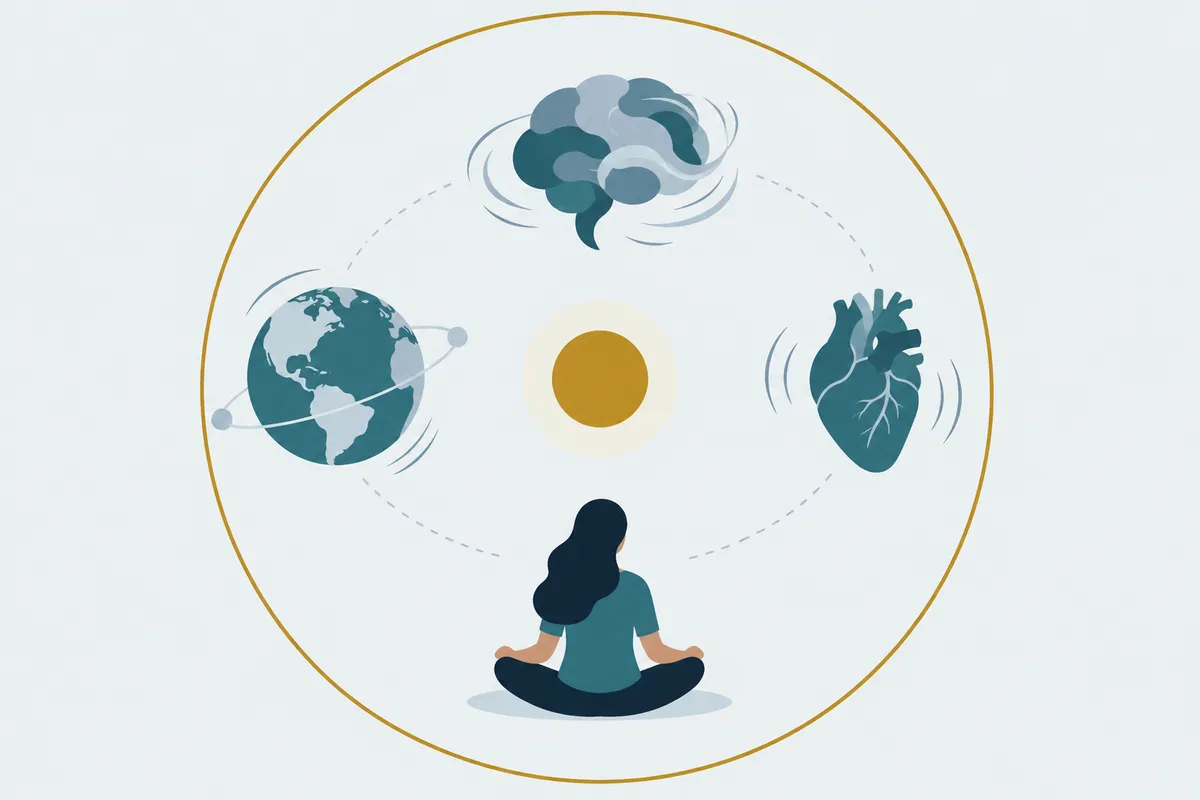
The Sandokai, “the identity of relative and absolute”, is recited in Zen halls much as the Heart Sutra is. It is best heard by listening to the silence between its words. Every word divides, while the poem points to what cannot be divided.
Nothing in the body is ever still: blood moves, food digests, brainwaves rise and fall. Yet “be still and know” points beyond form, not towards a frozen body. Teachings are fingers pointing at the moon; as Alan Watts put it, we “suck on the finger for comfort” when we cling to their words instead of looking.
The Zen saying about mountains and rivers maps three turns. At first mountains are mountains and rivers are rivers: concepts make a familiar world. Then mountains are no longer mountains and rivers no longer rivers: boundaries soften, inner and outer merge, energy and union replace certainty. Finally mountains and rivers simply are. Things no longer need a concept or a special glow to be sacred. Ramana Maharshi said of Arunachala, “the mountain is Shiva.” Sacred ground is not elsewhere; it is wherever you are awake.
The poem cuts through loyalties: “In the great way there is no northern or southern patriarch.” Schools differ; truth does not join a camp. “To be attached to things is illusion; to encounter the absolute is not yet enlightenment.” Losing yourself in form is one side, hiding in transcendence the other. “Within light there is darkness, but do not try to understand that darkness.” The mind cannot turn mystery into a possession.
Then come its homely precisions. Ordinary life fits the absolute as a box and its lid: no gap, no need to discard either. Absolute and relative meet “like two arrows meeting in mid-air”: not two realms joined later, but this exact encounter. “If you do not see the way, you do not see it even as you walk on it.” Reality is never absent, only overlooked. And the closing instruction is urgent without being dramatic: “Do not waste your time by night or day.”
Two arrows meet above the mountain and river with nowhere between them for a separate world to hide.

The Sandokai has to use sound to invite you into silence. Speaking about that silence breaks it. At some point the kindest gloss is to stop.
Rather than something philosophical, this is an entirely different way of interfacing with the world. Actually it is dropping the interface: dropping the reducing valve, which is the self-structure, and meeting your true nature unmediated by the limited mind.
On the still point
"If awakening is stepping aside and watching the show, is the mind left driving? Is everything scripted? Is there any real choice?" The question is honest and it has a structural answer: it only arises inside duality. It asks whether a separate "I" has free will, and the separate "I" is the illusion. The whole game of question and answer is played on the level of the egoic mind, and as long as we are caught in it we are not awake. Remove the separate "I" and the magic show is revealed: this character is being dreamed within the one mind, and the whole apparatus of choosing versus not choosing falls away with the dream character who was doing the choosing. Samsara and nirvana, the Buddhists say, are one and the same. The world does not change. What drops is the "I" that resisted it, and with it the sense that the show needs a director.
Every "how" question the mind asks about this (how do I be compassionate, how do I stop doing, how do I know what is evil) is the knowing knot asking for a facsimile it can operate. Give it an answer and it will build a persona out of it. The only useful reply is the Buddha's to Vacchagotta.
An advanced practice, once concentration is stable: hold two poles of a perceptual duality in mind at the same time and let them grind against each other until they collapse. Inside and outside. Doing and happening ("am I doing this or is it happening on its own?"). Self and other. Stillness and movement. Held together with real concentration, the filters wear thin, and when one breaks it stays broken, not only in meditation but all the time. This is how the last layers of identification go: not by belief, but by watching the mechanism that made the distinction until it can no longer make it. Then the great reality is simply as it is: neither self nor other than self.

The Hsin Hsin Ming ends here too: "when thought objects vanish, the thinking subject vanishes", "consider movement stationary and the stationary in motion, and both movement and rest disappear", and then, having gone that far, "although all dualities come from the One, do not be attached even to this One". Even the One, held as a concept, is a concept.
Buddhism: Mahamudra, "the great seal", in the Tibetan Kagyu lineage, is the teaching of resting in naked awareness without fabrication; Dzogchen is its sibling. The Heart Sutra's "no eye, no ear, no nose... no attainment and no non-attainment" is the same clearing of concepts done in verse. Nagarjuna's middle way refuses every position, including the position of having no position.
Hinduism: neti neti, not this, not this, is Vedanta's method of subtraction. The Kena Upanishad: "It is not understood by those who understand it; it is understood by those who do not understand it." The Tao's "those who know do not speak" has a Vedic cousin here.
Taoism: the opening line of the Tao Te Ching is the Buddha's silence in Chinese: the Tao that can be spoken is not the eternal Tao. A mind free of thought, merged within itself, beholds the essence of the Tao.
Christianity: the apophatic or negative theology of Dionysius, Eckhart and the Cloud of Unknowing approaches God by unsaying every attribute. Eckhart prayed to God to rid him of God, meaning the concept. "Be still, and know that I am God" is the practical instruction; its stillness is not of the body or the mind.
Sufism: Ibn Arabi's "unity of being" is also spoken of as beyond both unity and multiplicity. The Sufis distinguish knowledge from books (ilm) from tasting (dhawq); only the latter is knowledge of God, and it leaves the taster unable to say what was tasted.
Stage 10 of 10
Awakening is the beginning of the path, not its end. What follows is integration: the long, unglamorous, sometimes uncomfortable work of letting the whole human vessel catch up with what has been seen, until every moment is met fresh.
The flip can happen in a moment. Stabilising it takes countless small deaths, daily vigilance, and a willingness to feel everything life brings up, which will be more than before. The goal is a mirror mind: reflecting each moment without the distortion of memory. The old has passed; everything is new.
The pattern after any real glimpse is predictable enough to be a law. The mind comes back online. The ego drafts a story around the experience, takes ownership of it, and weaves it into a narrative: my awakening. Then the state fades and the story remains, a memory added to the self-structure, and the person starts talking about awakening as if they know. To stabilise and integrate samadhi requires, in the words of the tradition, countless awakenings, countless humblings of the mind, countless little deaths. Each time the mind claims the insight, it has to be seen and released again. This is not failure. It is the fan slowing down.
What sustains it is steady practice, sadhana, day in and day out: sitting, inquiry, watching the mind, freeing the inner energy so that the rewiring can proceed and the inner lotus can grow. Not practice as a technique to be performed, but as continuous presence, the recognition of being, carried into whatever is happening. If you are walking, walk. If you are eating, eat. In the seeing, only seeing. It does not require a cushion, though the cushion helps.
Here is what nobody says at the start: the more work you do on the cushion, the more feelings will come up in life. Not fewer. As the reducing valve opens, what it was filtering out arrives, and the practice must be applied there, in the kitchen and the meeting and the argument, or it is only half a practice.
The instruction is simple to state. Life triggers a stored knot, a samskara, and the body tightens: chest, solar plexus, throat. The habit is to close, to defend, to rationalise, to suppress, to reach for distraction. Instead: relax the body, soften the heart, and let the energy pass through. Do not close. Have a complete experience of the sensation, feeling and emotion as it moves, equanimous and inwardly surrendered. Every thorn you allow to be felt fully is one you no longer have to build your life around avoiding.

This takes brutal honesty, because the ego is extraordinarily skilled at hiding. Watch how it defends its worldview, presents itself in a good light, needs to be right, avoids the unpleasant, clings to the familiar, and feeds itself entertainment to avoid the present. It is entirely possible to be stuck in patterns and archetypes, playing out karma, while quoting non-dual teachings. The tell is always the same: is something being felt, or avoided?
Integration meets its real test in relationships and work, and a few things are worth knowing in advance.
Family and friends know the character. When you stop behaving as the character they know, there is friction. This does not have to be a split; it can be this and that. Trust the inner direction, make the pattern conscious, and stop trying to manage everyone's dynamics; the mind cannot do it and will shut down trying. "No thoughts, no problems. I don't mind what happens."
Other people's pain is contagious. When someone else's pain, what Eckhart Tolle calls the pain body, lands on you and your own picks it up, the mind loves to replay the story. Instead, feel how it moves in the body first, keep attention there, and do not feed the thoughts. The wave is big at first and then smaller each time. Practitioners who have learned not to believe their own thoughts also become good at not believing other people's.
Work and money. The anxious loop of "what should I do for work now?" is a thought pattern like any other. Two questions cut through it: what do you actually want to experience in this game, and what are you willing to pay for it? Where attention goes, energy flows, and a clear answer ("I want to help stressed people slow down; I would do it all day") is usually already known and being blocked by "but how would I make money?". The transitions can take years, and the mind will try to repurpose old patterns in new costumes; catch it when it does.
The energy makes corrections. After a real awakening there is, in practice, no going back into the old shape. Practitioners who have tried report that the freed energy will not allow it: illness, collapse of relationships that only worked for the character, an inner correction of some kind. This is not punishment; it is the current asserting itself. It is also different for everyone.
New abilities. Intuition, creativity, sometimes healing or perception that was not there before: the yogic texts call these siddhis, and warn about them. Do not push them away; do not build an identity on them. A tree needs branches to be healthy, and it still needs to grow toward the sun. When the branches become the whole tree, the path is forgotten.
And expect a period, often uncomfortable, when everything the character says sounds false to you. That is fine. It is part of letting go of what needs to be let go of.
A mirror reflects whatever is in front of it without holding onto it and without preferring one image to another. The mind that meets each moment this way is called, in Zen, beginner's mind; in the inquiry traditions, the don't-know mind; here, the mirror mind. It is the very essence of meditation and self-inquiry, and it is the destination of this path: not a state, but a way of meeting reality without the mediation of past conditioning.

When you are not experiencing through the filter of memory, each moment is new. Every religion has a word for this. The Christian one is exact: "If anyone is in Christ, he is a new creation. Old things have passed away; behold, all things have become new." And: unless you become as little children, you will not enter the kingdom. Not childish, but the child's spontaneity, the ease of being that has not yet been strategised. Rumi said silence is the language of God and everything else is poor translation, and yet there is a way for these human vessels to speak from silence, freely, without a little mediator managing the effect. That is authenticity: not a better performance, but life coming through unedited.
Compassion arrives here as a byproduct, not an achievement. Having found out who you are, you have found out who everyone is. A moral code is what a society builds when that direct knowing has been lost; it is downstream of the thing itself. Repair the split at its root and compassion is simply how energy moves through an undivided vessel.
Everything up to now has been freedom from: from the character, from suffering, from the fan. There is also freedom to. The awakened person is still here, in the dream, and the dream has other possibilities in it: to evolve, to grow this particular vessel in its unique way, to explore what the traditions call the higher worlds and the other dimensions of ourselves. The energy in the spine, the kundalini, is our evolutionary potential; the centres it moves through, the chakras, are the developing parts of the instrument. At the start the human journey is about survival. Then it expands: relationships, family, creating things in the world, an ever-larger sphere of compassion, until the sense of "I" includes everyone and everything. It is all you.
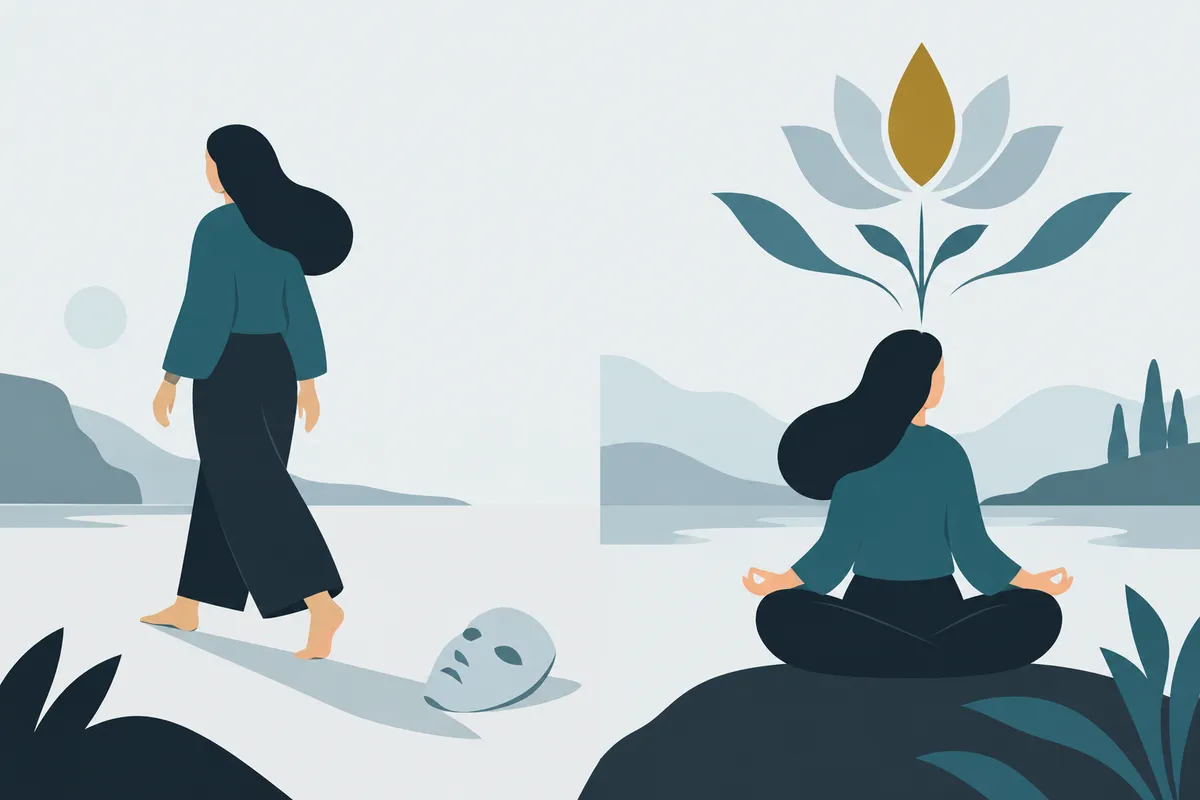
The highest samadhi, the traditions say, is when this awakened consciousness and the time-bound part of us become one: the vessel matured until awareness shines through it without interruption, a transparent expression of the whole. Always being Buddha; always becoming Buddha. The show goes on. The witness is at peace. The mask is off, and the play is better for it.
Kundalini is the evolutionary energy already moving through a human life; meditation accelerates it. Whenever a process of mind drops away, the energy tied up in running it is freed. Dhyana, jhana, Chan and Zen are one travelling word, rooted in burning: meditation burns conditioning, and what was bound becomes available.
Every awakening carries some activation of this force, but the two unfold on different clocks. Awakening is formless and only now; it needs no stage of development. Energy belongs to form and develops through time. The old trinity helps hold both. Purusha is pure awareness, the Father. Prakriti is animating spirit or Mother, the energetic principle Christianity often leaves unnamed. Ishvara is the Son: big mind awake in form. Together they are the jewel in the lotus — awareness shining through a flowering human instrument.
The crown is pictured as a thousand-petalled lotus because the unfolding has no tidy end. Maslow’s ladder finishes at self-actualisation; Sri Aurobindo’s account of human evolution begins there. Attachment to any rung slows the movement, whether the attachment is to safety, a beautiful state or a spiritual belief added to the self-structure. You can awaken at any stage, and awakening itself accelerates growth. Always being Buddha; always becoming Buddha.
Ancient images place nāgas, serpents from the waters of the unconscious, calmly at attention around an awakened being. Nothing has been killed. What was hidden now serves awareness. Guanyin rides the dragon rather than slaying it: integrated power at her back, not an enemy under her feet.
The opening is personal. An acorn becomes an oak, but the oak grows differently on a hillside and in a sheltered valley. In the same way, one lotus flowers through art, another through family, service, solitude or an ordinary job. Environment shapes the tree without supplying its inner instruction.
The seven serpents rise calmly around the seated figure, attentive to the lotus opening above.
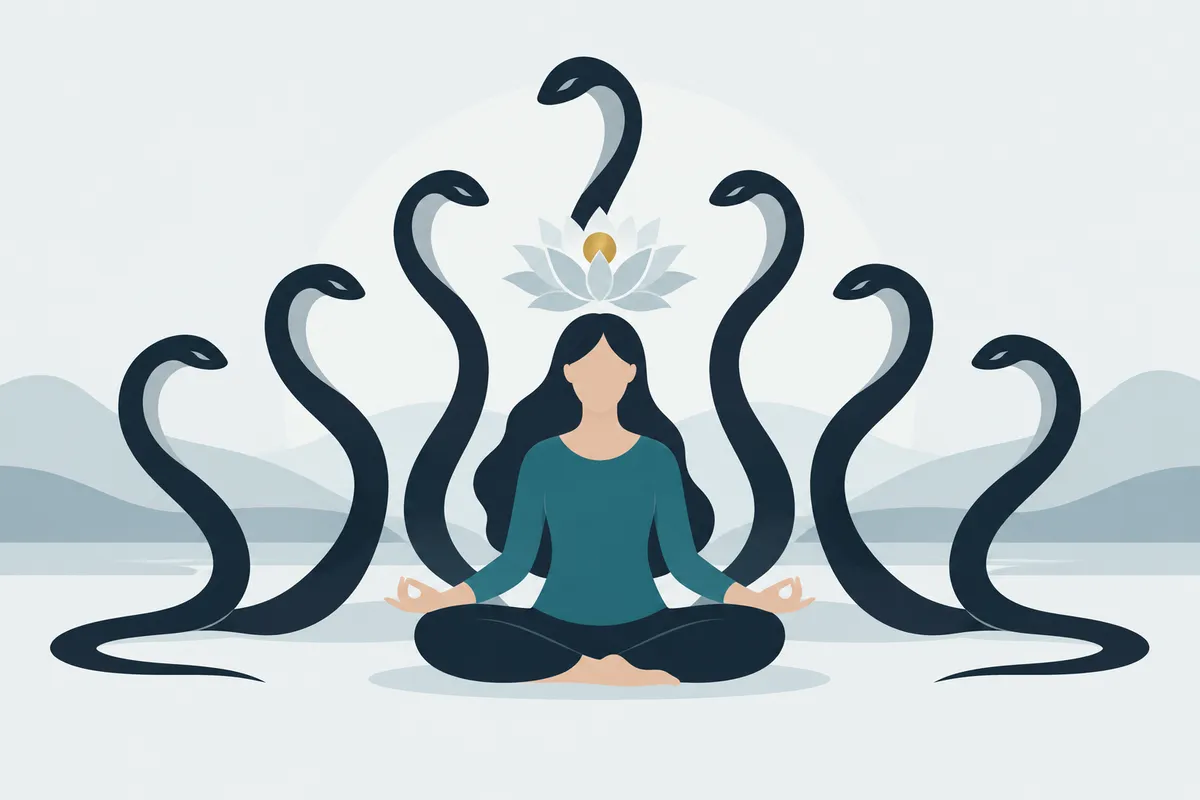
Some people feel heat, movement, visions or strong currents; others follow the “dry path”, awakening by direct insight without much energetic display. Neither is more real. Chakras do not open as a reliable linear checklist, and different maps count and describe them differently. Turn any map into a programme and the ego has another game to win. Let the actual life teach you. The more awake you are, the more freely the lotus unfolds; the more it unfolds, the more transparent the vessel becomes. There is no need to rush the flower. Enjoy the journey.
The three prongs of Shiva’s trident hold one pattern. In Vedic language they are Purusha, Prakriti and Ishvara: pure awareness, the power that animates form, and awareness embodied as big mind. In Christian language they are Father, Spirit and Son, though the Spirit’s maternal, energetic character is often obscured.
In plain language: awareness, energy, awakened form. Awareness without form is the jewel; energy is the lotus’s living growth; awakened form is the jewel shining through the open flower. These are not three substances stacked together. They are three ways of meeting one reality: what never changes, the movement by which worlds appear, and a life transparent to both. The trident is useful when it keeps formless awakening distinct from development through time, and should be put down when it becomes another diagram to defend.
To find the truth that you know not, you must go by a path that you know not.
St John of the Cross
The Mandukya Upanishad describes three ordinary states, waking, dreaming and deep sleep, and a fourth, turiya, which is not a state alongside them but the awareness underlying all three. In periods of intensive practice, practitioners sometimes discover that awareness remains when the mind drops off at night: the conditioned self is gone, and something is still present. This cannot be made to happen; it is a byproduct of continuous inquiry. Ramana Maharshi described it as a place where there is no more coming and going, an opening into the timeless, for as long as it lasts. Its stabilised, open-eyed form is sahaja, the natural state, in which primordial awareness is recognised as ever-present while life and death arise within it.
Turiya is the experiential answer to the question of Stage 9: what does not change? Not the waking self, which dissolves each night. Not the dreamer. Not the blank of deep sleep. What knows all three.
Zen: the ten ox-herding pictures end not with the empty circle of realisation but with the tenth image, "returning to the marketplace with open hands": an ordinary person in the world, and everyone they meet becomes enlightened. Integration is the last picture, not the eighth.
Hinduism: the jivanmukta is one liberated while living, moving in the world without bondage. The Gita's ideal is the person of steady wisdom who acts fully and claims nothing.
Sufism: after fana comes baqa, subsistence: the self has been annihilated and the servant returns to serve, "in the world but not of it". The Sufi stays in the caravanserai; the saint sells cloth in the bazaar.
Christianity: the new creation of 2 Corinthians 5:17; Paul's "it is no longer I who live"; the kingdom within, lived out. The mystics who finished the dark night did not leave the world; Teresa reformed convents and John wrote in a prison cell.
Taoism: the sage is indistinguishable from an ordinary person, "muddled and murky like everyone else", and does nothing, and nothing is left undone. Before enlightenment, chop wood, carry water; after enlightenment, chop wood, carry water.
Reference
The path is not abstract. The same things arise for almost everyone who sits and inquires seriously, and most of them are frightening only when they are unexpected. This guide collects the questions that come up in retreat after retreat, with the answers the teaching gives.
When turbulence arises in practice, it helps to know which of four things it is, because they call for different responses.
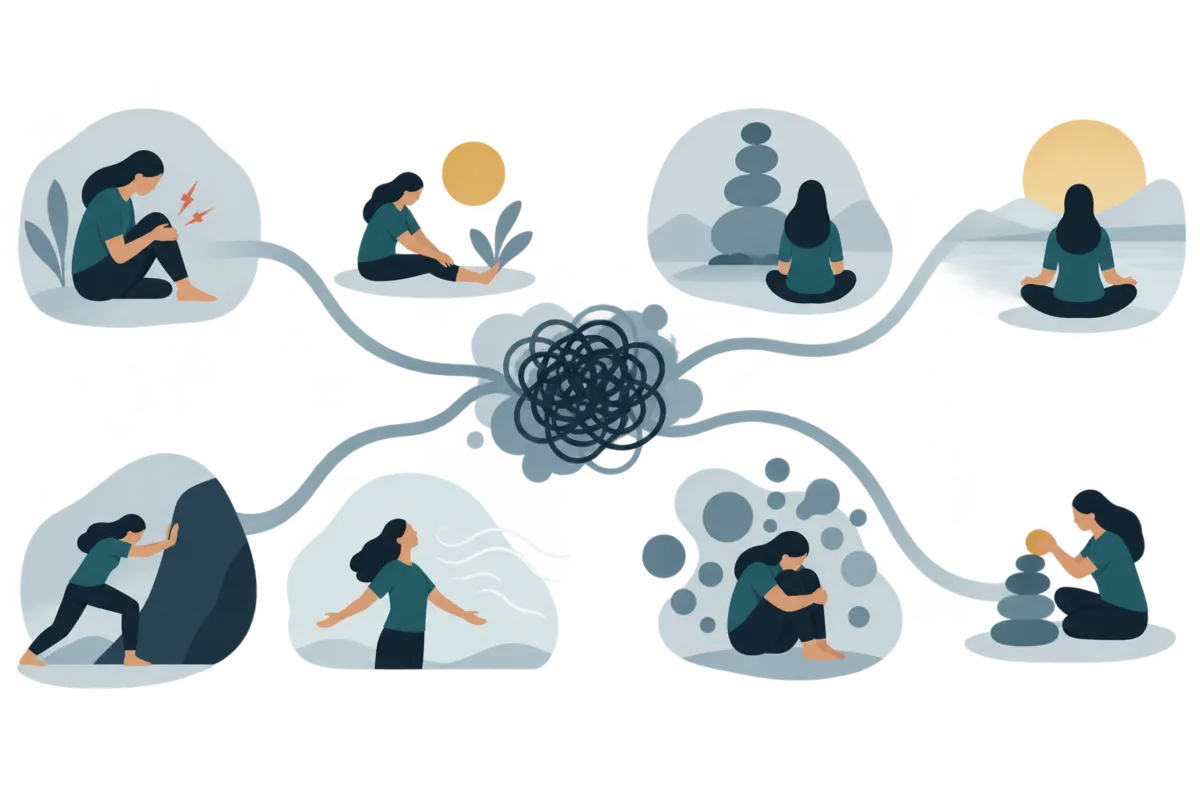
| If it is | What is happening | What to do |
|---|---|---|
| Biological pain | The body's intelligence signalling a real problem: injury, a nerve, faintness, tunnel vision, a chronic condition. | Do not brutalise the vessel. Adjust posture, use props, switch to walking meditation, stop. Consider yoga or qigong to prepare the body for sitting. |
| Karmic pain (samskaras) | Habit patterns of the mind manifesting as aches that exist only while sitting, restlessness, the squirm, tears, waves of emotion. | Remain equanimous. Sit still and let the energy build and break through. Track it as sensation; do not feed the story. Ask to whom it belongs. |
| Boredom / resistance / doubt | The ego starved of entertainment, or wanting something to happen, or questioning the whole enterprise. | Observe the striving itself. Accept the seeker as a contracted pattern. Inhabit the boredom fully; it is a hindrance showing you where to look. |
| Overwhelm | The nervous system overloaded; equanimity completely gone; shaking, sweating, a sense of the system going down. | Pause the technique. Ground: walk barefoot outside, drink water, sleep, do ordinary tasks. Return when stable. If it persists, seek support. |
In sitting
Energy, visions and strange states
Glimpses and losing them
Fear and darkness
Inquiry and dyads
Life
Reference
The original words, in Pali, Sanskrit, Chinese, Arabic, Greek and Hebrew, carry precision that English translations lose. Each entry gives the term, its source language, and the meaning it has on this path.
The self and its machinery
Momentum
Practice
Realisation
Mythic figures
Reference
Five lineages, one mechanism. The table below lines up the core ideas of this path with the words each tradition uses for them. The vocabularies differ; the pointing does not. Where a tradition is quiet on a point, the cell says so rather than inventing a parallel.
| This path | Buddhism | Hinduism / Yoga | Taoism | Sufism | Christianity |
|---|---|---|---|---|---|
| Awareness, the true "I" | Buddha-nature; tathagatagarbha; the unborn | Atman, not other than Brahman; the Self (Ramana) | The Tao within; the uncarved block; "a mind free of thought beholds the essence of Tao" | The Real (al-Haqq); the heart (qalb) as the seat of knowing | I AM (Exodus 3:14, John 8:58); the kingdom within; the true self (Merton) |
| The false self / character | The five skandhas; the deluded mind | Ahamkara (the I-maker); the koshas (sheaths); jiva | The contrived, striving mind; "learning" as opposed to the Tao | The nafs, especially the "commanding" nafs | The old man; the flesh; the false self "made of shoulds" |
| Conditioning and momentum | Sankhara; karma; dependent origination | Samskara, vasana, klesha; karma | Accumulated learning, dropped daily (ch. 48) | The habits of the nafs; veils (hijab) | Habit as a chain (Augustine); sin as missing the mark |
| Suffering | Dukkha, from craving (tanha) | Duhkha; bondage from ignorance (avidya) | The cost of striving against the flow | Separation from the Beloved; the reed's lament (Rumi) | Exile; the fall; the far country of the prodigal |
| No preferences | Upekkha (equanimity); "in the seen only the seen"; the Hsin Hsin Ming | Samatva: "yoga is evenness of mind" (Gita 2.48) | Wu wei; the way of water; heaven and earth have no preference | Rida (contentment); "The Guest House" | Thy will be done; holy indifference (Ignatius); Gelassenheit (Eckhart) |
| Concentration | Samatha; samadhi as one-pointedness | Dharana; the eye of the bird | Guarding the One (shouyi); gathering the chi | Muraqaba (watchfulness); dhikr | Recollection; the ascent of Mount Carmel, "look neither left nor right" |
| Absorption | The jhanas, material and immaterial | Dhyana; savikalpa and nirvikalpa samadhi | Sitting and forgetting (zuowang) | Fana; the states (ahwal) and stations (maqamat) | Infused contemplation; the mansions of the interior castle |
| What remains in deep sleep | Deep kenshō / nirvikalpa; Buddha-nature | Turīya; the Self | The Tao that does not move | The Beloved present in fanā | The “I am” before Abraham; the kingdom within |
| Direct inquiry | Koan; "who is hearing?"; the Buddha's silence | Atma-vichara: who am I?; neti neti | "The Tao that can be spoken is not the eternal Tao" | "He who knows himself knows his Lord" | "Be still, and know"; the Cloud of Unknowing |
| Fear and the dark passage | Mara's assault; wrathful deities; the charnel ground | Kali; Shiva the destroyer; the serpent power | Yin; "know the white, keep to the black"; the valley | "Die before you die"; the bandaged place where the light enters | The dark night of the soul; descent into hell; "abandon all hope" (Dante) |
| The shadow, integrated not slain | Nagas around the Buddha; poison as medicine (tantra) | Arjuna's battle; nagas around Patanjali; the two horses (Plato, adopted) | Yin and yang as one circle; the sage embraces both | The nafs transformed, not killed; Iblis as the veiled lover (some Sufis) | The fallen angel as the ego; Jung's "making the darkness conscious" |
| Beyond concepts | Silence to Vacchagotta; the Heart Sutra; Nagarjuna's middle way; Mahamudra | Neti neti; Kena Upanishad: "not understood by those who understand" | "Those who know do not speak"; the nameless | Dhawq (tasting) over ilm (book knowledge); beyond unity and multiplicity | Apophatic theology; "God rid me of God" (Eckhart) |
| The union state and its aftermath | Nirvana; "form is emptiness, emptiness is form" | Samadhi; sat-chit-ananda; turiya; sahaja | Return to the source; the ten thousand things as one | Fana then baqa; "I am the Truth" (al-Hallaj) | Union; "it is no longer I who live"; the spiritual marriage (Teresa) |
| Integration; living it | Returning to the marketplace (10th ox-herding picture) | Jivanmukta; the person of steady wisdom (Gita) | Chop wood, carry water; the sage "muddled like everyone else" | Baqa; in the world but not of it | The new creation (2 Cor 5:17); become as little children |
| Compassion as byproduct | Karuna arising from the realisation of anatta | Seeing the Self in all beings (Gita 6.29) | The sage's kindness without intention (ch. 49) | Love (ishq) as the path itself | Love of neighbour flowing from union; "God is love" |
Two cautions. First, these are correspondences, not equations. The yoga sutras and the Buddhist jhana maps agree about ninety percent of the time, which is astonishing for independent systems, but the ten percent is real and the traditions argue about it. Second, the map is itself a concept, and Stage 9 applies to it. A person can memorise every column and be no closer than when they started. The table's only use is that when something arises in your own practice, you can recognise it in five languages and be less afraid.
The deepest agreement is the simplest. Every one of these traditions holds that what is being sought is already present, that the seeker is what obscures it, and that the way is a subtraction rather than an acquisition. The Tao Te Ching says it in a line: in the pursuit of the Tao, every day something is dropped.
Reference
The teaching travels in pictures because the mechanism it describes cannot be seen directly by the mind that runs it. Here is every image used on this site, with what it points at and where it is developed.
Life is a current flowing back to its source; awakening is a point in that flow, not a summit to climb. Resisting the current is suffering; swimming with it is choiceless awareness.
Companion image: the torus, the continuous loop of going out and returning.
You are the one on the sofa, not the protagonist on screen. Absorption in the drama is not bondage; remembering where you sit is not liberation. It is the end of a mistaken identity.
Variants: the movie-goer who forgets they are in a seat; the actor who has forgotten it is a play.
How the character acts in the awake state: with precision and ease, and with no one standing behind the process approving each strand.
If you are thinking about the next move you are already finished. Energy moves from belly, heart and brow in one dance; the thinker is not in it.
The five skandhas in two seconds: a body, a raw vibration, the label "mosquito", the reaction "bad", and the camera of attention watching it all.
Fixation on shadows (thoughts, images, perceptions) mistaken for reality. Awakening is walking out into the sun, and there is no real going back.
How the false self begins: a child's attention goes naturally to aliveness; the teacher says pay attention; the child learns that following its energy gets it into trouble, and builds a persona to please.
Concentration turns and focuses, narrow or wide; the fifth skandha is this camera. Awareness is not the camera; it is what the camera and its pictures appear in.
Put attention on your hand and it tingles. Nothing changed but where attention went. Chi follows consciousness; the self-structure is powered by being looked at.
Samskaras are channels cut by past water; karma is water following them. Practice is the outside force that stops feeding the channel until it fills in.
Awakening pulls the plug; the blades keep spinning on momentum. Every reaction to a preference plugs the fan back in. Practice is noticing the hand on the socket.
The body tied to comfort, the mind tied to knowing. Every hindrance is one of the two pulling. Present without choosing loosens both.
Techniques are used to interrupt the pattern of the mind and then discarded. Kept, they become a new layer of the self-structure.
Companion: making the thief the chief of police, Ramana's warning about letting the mind run the practice.
Patanjali's image of attention: a continuous stream, not drops. Concentration chooses the object; attention keeps it.
Arjuna sees only the eye of the bird. Single-pointedness: not the tree, the crowd, the arrow, or the clever answer that there is no bird.
St John of the Cross: climb straight, look neither left nor right, do not stop for the flowers, do not be scared off by the creatures.
Breath is the bridge; energy is the bridge. Any meditation object leads into the same pranic field, where watcher and watched merge.
Inhabit the phenomena, or inquire directly: the self-structure is one candle, and it does not matter which end burns.
A noisy apartment or a hard life is training with weights on, said the monk in Las Vegas. Weights can be too heavy; only you can feel the line.
Benefits everything, competes with nothing, seeks the low places, and overcomes the rigid by yielding. Wu wei is not passivity; water is never in conflict with the shape of things.
Thirty spokes meet at the hub but the hole makes the wheel turn; clay makes the cup but the emptiness holds the water. Usefulness lives in what is not there.
Runs away (bad luck?), returns with wild horses (good?), the son breaks his leg (bad?), the army passes him over (good?). Maybe. I don't know. The mind is not qualified to judge life.
Maps of the jhanas, and this website, describe the meal. Do not mistake reading the menu for eating.
Companion: mistaking the map for the territory; dharma as checkboxes.
A line from union-bliss at one end to hellish separation at the other; every moment is somewhere on it. What you are is the awareness of the whole line, and is at neither end.
Begging for coins while sitting on a treasure, never looking inside. Seeking pleasure in form while the bliss of pure being is under you.
Some ignite at a direct pointer; others need time to dry. Most are wet wood for a while, and then are not.
Companion: the Buddha's flower sermon, where one student in the assembly understood.
Self-inquiry. Give up control, give up knowing, surrender, and in the stillness of surrender experience the truth.
The felt distance between a remembered glimpse and now. There is no gap; there is a memory of phenomena being compared to present phenomena, while awareness is unchanged in both.
Hold on and the energy is fear; let go and the same energy is aliveness. Two ways to ride: as the empty witness (peaceful, removed) or non-dually (emptiness and fullness together, life itself riding).
Plunge in tense and it is shock; let go and, in time, the nervous system learns the shock was the resistance. The same is true of the letting-go the little self fears.
What feels like death to the character is the conditioned self moving from driver to passenger. It stays on the team; the ride gets more interesting.
Companion: the conditioned mind makes a good servant but a poor master.
Fear is a terrifying facade with nothing behind the curtain. Seen clearly, the snake is a rope, and there is nothing to fear and never was.
"Abandon all hope, you who enter here." Hell is the ego structure; to pass through it, abandon hope and fear together, because they are one mechanism.
Told he will not need his weapon, he takes it, strikes down Darth Vader, and the mask opens on his own face. The thing feared most in the dark is a disowned part of oneself.
Companion: Joseph Campbell, "where we had thought to slay another, we shall slay ourselves".
Seven serpents fanning behind the awakened one in the old temples: the dimensions of the unconscious, integrated and at attention. Not slain. The hero rides the dragon.
The most beautiful angel splits from the One: "rather to rule in hell than serve in heaven". That is the ego, my will not Thine. The demon and the angel are one energy.
Black horse eros pulls toward the material; white horse thumos toward the spiritual. Kill neither; drive both. Lose one and you lose half your power or leave the road.
What is pushed away in oneself returns through relationships, triggers and synchronicities. The person who repels you is showing you an exile.
The self-structure filters reality down to what the ego can manage. Awakening is dropping the interface, not improving it.
"Be still" cannot mean the body, on a globe turning at a thousand miles an hour, or the mind, which is movement. The stillness meant is beyond stillness and movement: emptiness dancing.
Hold both poles of a duality (inside/outside, doing/happening) together with real concentration until they wear thin and break. Once broken, they stay broken.
"No-self" held as a belief and worn as a persona. Not less of an ego for being made of a true idea.
Each time the ego claims an insight, the claim must be seen and released. Stabilising awakening is this, repeated, until the fan has stopped.
A stored knot that life keeps brushing. Build a life around avoiding it, or feel it fully once and be free of the avoidance. Relax, release, keep the heart open.
New abilities are branches; a healthy tree needs them. It still needs to grow toward the sun. When the branches become the whole tree, the path is forgotten.
Reflects whatever is in front of it without holding or preferring. The mirror mind meets each moment without the mediation of memory. Old things have passed away.
The maturing of the human vessel after awakening: freed energy grows the instrument until awareness shines through it permanently. Always becoming Buddha.
An avatar and its world can change while the one playing remains the same. The one who puts on the headset is the one who takes it off.
The vase is the whole sensory field; flip the picture and the faces become the witness. Both are inside the picture, known by what is aware of the flip.
The conditioned self can be polished for a lifetime without becoming awareness. Practice prepares the ground, but the tile was never the mirror.
When the beard slips and the child sees an uncle, the old belief cannot fully return. Recognition of true nature is likewise not a passing state that can simply be unseen.
The scarab rolls from the moon's borrowed light towards the sun without complaint. It is the evolutionary force already moving before the mind asks how to manage it.
The snake eating its tail and the cat spinning after its own show seeking caught in a self-powered loop. The one searching for itself is the very movement that hides it.
Nature dissolves the caterpillar and forms a butterfly through effortless effort. The ego would prefer to stay in charge and become only “a caterpillar with wings”.
First concepts make mountains and rivers familiar; then merging removes their boundaries. Finally they simply are, without needing either label or spiritual glow.
Ordinary life fits the absolute as closely as a box fits its lid. Neither half has to be discarded for the fit to be exact.
Absolute and relative meet point to point with no gap. They are not separate realms that must later be joined.
A teaching points beyond itself as a finger points at the moon. Clinging to the words for comfort means never looking where they point.
An acorn carries the inner direction of an oak, while hillside and valley shape the tree it becomes. Each human lotus likewise unfolds in its own life and conditions.
The jewel is awareness; the lotus is the flowering human instrument. Kundalini grows the lotus so the jewel can shine through form.
Reference
The whole teaching as one system: a baseline, three inputs, a crucible, and four outcomes. This is the view to build a course or an app from, because it shows what each practice does to what, and in which order things tend to happen.
Stages 1–3
Stages 4, 5, 7
Stages 6, 8, 9; field guide
Stages 6, 9, 10
The system runs as a loop, not a line. A practice (zone 2) interrupts the baseline (zone 1). The interruption pushes material into the crucible (zone 3): a samskara surfaces, karmic pain is met, fear is triggered, and, if equanimity holds and the story is not fed, the energy is rerouted from resistance into aliveness. Each pass through the loop produces a little more of zone 4: a state, a glimpse, a stabilisation. Each pass also offers an error: the state is grasped, the glimpse is appropriated into a persona, the fear tips into overwhelm. The error routes back to zone 1 as a new samskara. The correction is always the same: no preference, feel it fully, ask who it belongs to.
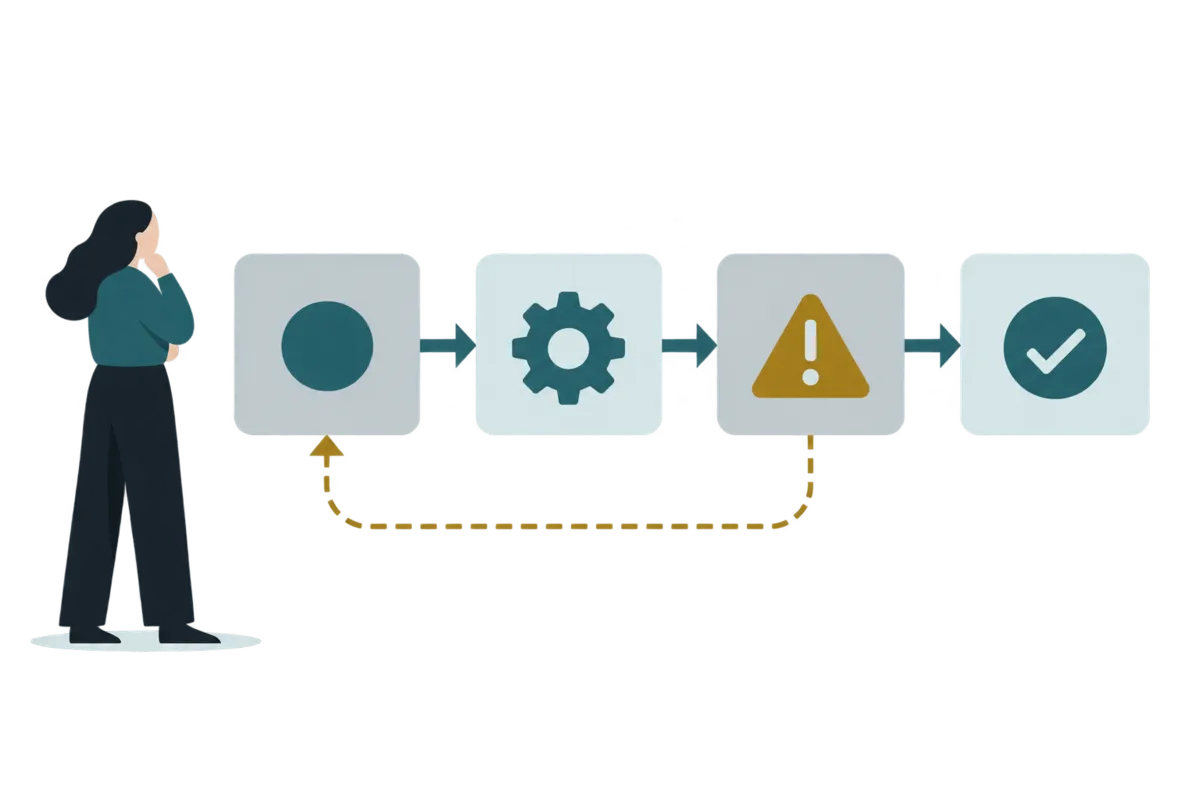
Every stage on this site has the same four parts, and they are the four things a learner can actually do. For a course or an app, these are the lesson types.
| Lesson type | What it trains | Example from this site | How it could be checked |
|---|---|---|---|
| Recognise | Seeing the mechanism in plain words: naming a skandha, a knot, a hindrance, a trap, when it appears. | The mosquito in slow motion; the fan; the triage table. | Short self-checks: "at which step does suffering enter?"; spotting the plug in a scenario. |
| Feel | Contact with raw sensation before the label; tracking a pattern in the body; equanimity with what is there. | Five steps in slow motion; catching the hand on the socket; tracking fear. | Timed sits with a single instruction; a log of "caught it" moments; body-scan check-ins. |
| Inquire | Turning attention toward the one who is aware; letting the mind fail; the imperative. | The one on the sofa; who knows this state?; solo inquiry and the dyad. | Guided inquiry sessions; paired dyads with a timer and strict witness rules; reporting what arose. |
| Release | Not preferring; relaxing the body; keeping the heart open; letting a state or a claim go. | The farmer's mind; resting in naked awareness; relax, release, and the evening mirror. | Daily "maybe" practice; the evening mirror as a nightly entry; noticing appropriation after an insight. |
| Stage | Core recognition | Practice | The trap to watch for |
|---|---|---|---|
| 1 · The Current | Character vs awareness; awakening as a current; choiceless awareness | The one on the sofa | Treating awakening as a distant summit |
| 2 · How a Self Is Built | The five skandhas; Plato's cave; energy follows attention | Five steps in slow motion | Taking the inner witness for the true self |
| 3 · Momentum | Samskaras; karma as inertia; the fan; the two knots | Catching the hand on the socket | Meditating while leaving life's sockets in place |
| 4 · Sitting | Concentration + surrender; attention vs awareness; hindrances as material; productive vs unproductive pain | A twenty-minute sit | The technique becoming part of the self-structure |
| 5 · No Preferences | The disease of the mind; wu wei; the farmer's maybe; compassion as byproduct | The farmer's mind | Confusing preference with discernment; passivity |
| 6 · Absorption | The jhanas; samadhi with seed; the one mistake; the continuum | Who knows this state? | Grasping a state; the birth of the seeker |
| 7 · Who Am I? | The I-thought as resistance; the imperative; the mind's failure as the door | Solo inquiry, then the dyad | Striving; the gap; prompting witnesses |
| 8 · Fear and the Shadow | Fear as contracted aliveness; hope and fear as one; ride the dragon; two horses | Tracking fear in the body | Feeding the narrative; overwhelm; imagining figures of light |
| 9 · Beyond Concepts | The Buddha's silence; three marks as experience; the spiritual persona; the still point | Resting in naked awareness | No-self as a sacred cow; bypassing |
| 10 · Living It | Countless small deaths; feeling life; the mirror mind; freedom to | Relax, release, and the evening mirror | Appropriating the insight; the branches becoming the tree |